


Tether is making headlines by integrating its USDT stablecoin into Bitcoin’s Lightning Network, through the Taproot Assets protocol, which gives Bitcoin a serious, but sometimes controversial upgrade.
Stablecoins on Bitcoin?
This partnership was unveiled at the ongoing Bitcoin-focused Plan B conference in San Salvador, El Salvador.
Tether CEO Paolo Ardoino and Lightning Labs CEO Elizabeth Stark took the stage to share the news, and you could practically feel the hype in the air.
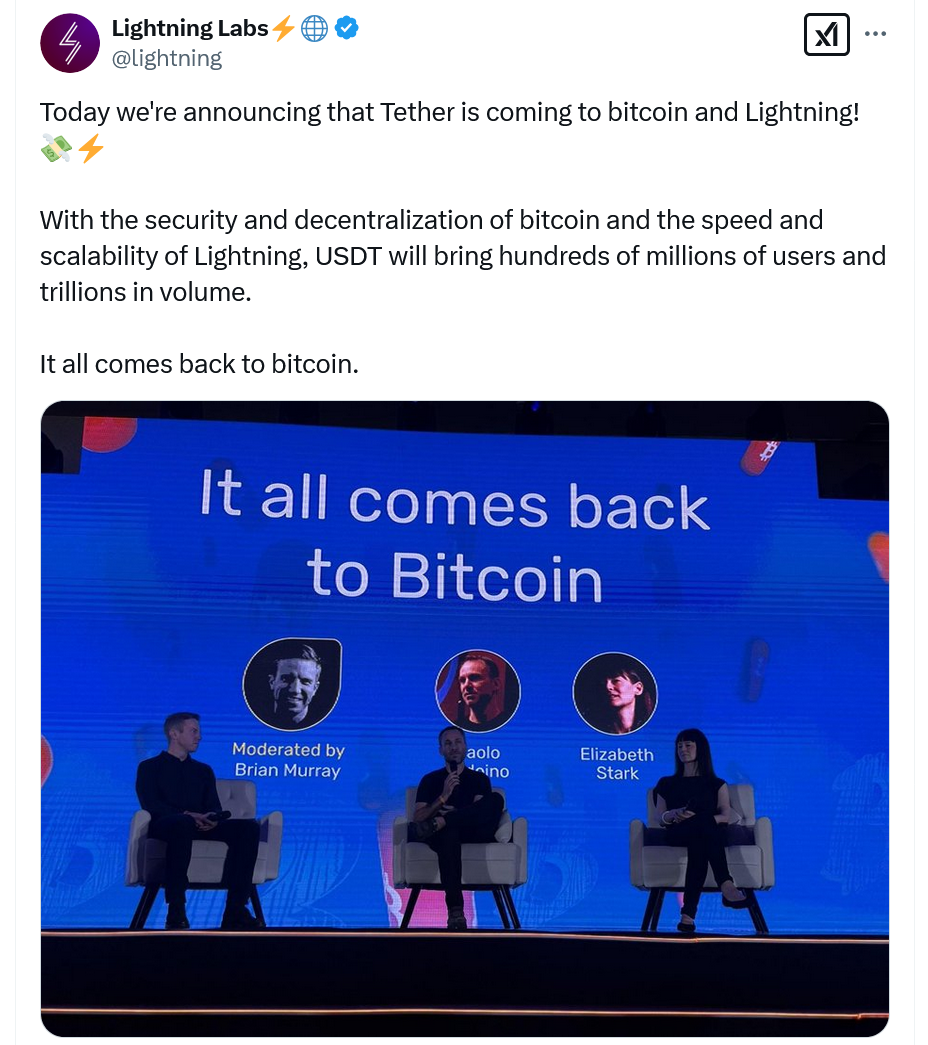
Tether is currently the heavyweight champion of stablecoins, with a market cap of $139.4 billion, and that’s nearly three times more than its closest competitor, Circle’s USD Coin, which sits at $53.1 billion.
In 2024 alone, Tether processed $10 trillion in transactions, inching closer to payment giant Visa’s $16 trillion.
And let’s not forget, Tether operates across more than 10 blockchains, including Ethereum, Tron, Solana, and Avalanche.
New payment option, without the volatility
With this new integration, merchants who accept Bitcoin via the Lightning Network can now add USDT as a payment option without breaking a sweat.
Stark noted that millions of people will now be able to use the most open, secure blockchain to send dollars globally.
This is especially important for those in emerging markets who often turn to stablecoins as a safety net against their local currencies losing value.
Lightning Labs hinted that this integration could pave the way for a future wave of transactions involving artificial intelligence and autonomous vehicles.
Imagine paying for your self-driving car ride with USDT, how futuristic is that? Except now it’s almost the present.
Bitcoin is still here
Tether also made headlines by relocating its operations to El Salvador, the only country where Bitcoin is officially recognized as legal tender.
Back in September 2021, El Salvador launched its own Bitcoin Lightning Network-supported Chivo Wallet for residents, but let’s just say it hasn’t exactly been a runaway success.
Merchants in El Salvador were initially required to accept Bitcoin as payment. But due to some pushback, and maybe a few grumbles, they’ve recently made it optional as part of a $1.4 billion loan deal with the International Monetary Fund.
