



The Digital Chamber has formed a new Prediction Markets Working Group and asked U.S. regulators for clearer prediction market regulation.
The blockchain advocacy group said it launched the working group on Tuesday and set a multi year plan focused on CFTC oversight.
Stay ahead in the crypto world – follow us on X for the latest updates, insights, and trends!🚀
It described prediction markets as a “misunderstood segment of finance.”
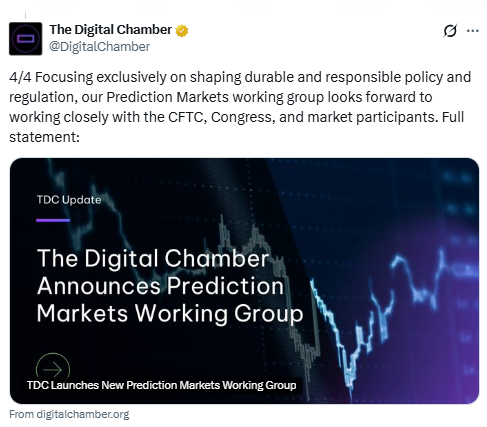
The group said it wants the Commodity Futures Trading Commission (CFTC) to keep primary authority over prediction markets.
The announcement came as state regulators and platforms fight in court over whether some contracts count as regulated derivatives or illegal gambling.
Digital Chamber starts Prediction Markets Working Group and backs CFTC oversight
The Digital Chamber said the Prediction Markets Working Group will support the sector and press for clearer prediction market regulation in the United States.
The group said its first move was a letter to CFTC chairman Mike Selig. It praised his stance on federal jurisdiction and called for an end to “regulation by enforcement.”
“In our letter, we applauded Chair Selig’s recent statements regarding the intent for CFTC staff to provide tailored rulemaking and guidance for this rapidly growing segment of the financial and digital asset industries,”
The Digital Chamber said.
The group also said operators have faced “a maze of regulatory ambiguity including unclear overlaps between federal and state regulators.” It framed that overlap as a key issue for prediction market regulation.
It said the working group will keep engaging with the CFTC. It also said it will develop policy principles and submit policy recommendations tied to CFTC oversight.
The Digital Chamber added that it plans to publish research and build a coalition of stakeholders and participants.
It also said it may take part in litigation through friend of the court briefs, to explain what it called the CFTC’s “historic regulatory exclusivity” over prediction markets.
Kalshi targeted by Nevada Gaming Control Board as state regulators challenge prediction markets
The debate over prediction markets has moved into fresh legal conflict at the state level.
Kalshi, a major prediction market platform, faced a civil enforcement action from the Nevada Gaming Control Board on Tuesday.
The board sought an injunction to stop Kalshi from offering what it called “unlicensed wagering” in the state.
The action reflects a wider state push against contracts that resemble sports betting.
State regulators have challenged offerings such as sports related contracts and have argued that the products operate as unlicensed gambling.
The pressure has not stayed limited to one platform. The same state focused arguments have also reached Polymarket, which has faced efforts by multiple state regulators to stop certain markets.
Last week, Polymarket filed a federal lawsuit against Massachusetts. The filing aimed to block potential enforcement and argued that CFTC oversight applies to the sector, not state governments.
CFTC oversight dispute sharpens as Mike Selig and Spencer Cox trade remarks
The conflict now includes direct public messaging about who controls prediction market regulation.
Mike Selig has repeated that the CFTC has authority in this area. “Prediction markets aren’t new — the CFTC has regulated these markets for over two decades,” Selig said in a video posted to X on Monday.
State leaders have pushed back against that framing. Utah Governor Spencer Cox welcomed possible legal fights with the CFTC and labeled prediction markets as gambling.
“Mike, I appreciate you attempting this with a straight face, but I don’t remember the CFTC having authority over the ‘derivative market’ of LeBron James rebounds. These prediction markets you are breathlessly defending are gambling—pure and simple,”
Cox said.
The Digital Chamber’s new Prediction Markets Working Group sits inside this dispute.
The group said it will keep working with the CFTC, while state regulators continue to challenge platforms like Kalshi and Polymarket over how prediction markets should be regulated.
Disclosure:This article does not contain investment advice or recommendations. Every investment and trading move involves risk, and readers should conduct their own research when making a decision.
Kriptoworld.com accepts no liability for any errors in the articles or for any financial loss resulting from incorrect information.

Tatevik Avetisyan is an editor at Kriptoworld who covers emerging crypto trends, blockchain innovation, and altcoin developments. She is passionate about breaking down complex stories for a global audience and making digital finance more accessible.
📅 Published: February 18, 2026 • 🕓 Last updated: February 18, 2026
