

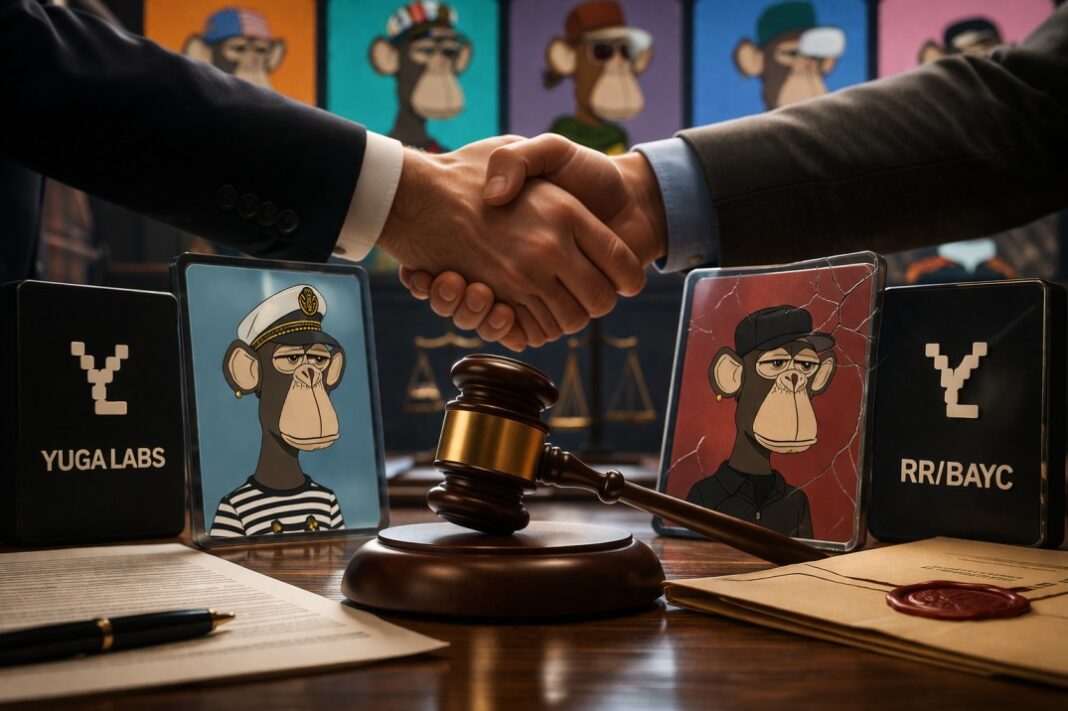

Yuga Labs has settled its long-running NFT lawsuit against artists Ryder Ripps and Jeremy Cahen, ending a dispute tied to the Bored Ape Yacht Club collection and the copycat RR/BAYC NFTs.
Court documents filed Tuesday in the District Court for the Central District of California show that Yuga Labs, Ripps, and Cahen reached a settlement agreement. Under that deal, Ripps and Cahen are permanently banned from using Yuga Labs imagery and trademarks.
Stay ahead in the crypto world – follow us on X for the latest updates, insights, and trends!🚀
The settlement also requires them to transfer control of the smart contracts, domains, and any remaining RR/BAYC NFTs to Yuga Labs within the next 10 days. In addition, the court ordered the two artists not to
“transfer, assign, conceal, or otherwise dispose of any NFTs, domains, accounts, or other assets referenced in this Injunction, or cause any of the foregoing, for the purpose of avoiding or frustrating compliance.”
Yuga Labs settlement stops the Bored Ape Yacht Club court fight
The Yuga Labs settlement closes a legal battle that started in June 2022. At that time, Yuga Labs sued Ryder Ripps and Jeremy Cahen over the RR/BAYC NFTs.
According to the lawsuit, Yuga Labs said the pair copied its Bored Ape Yacht Club cartoon ape images, sold similar NFTs, and made millions while buyers confused the two projects. Therefore, the company argued that the artists used its brand and images without permission.
The matter was later scheduled for a jury trial after earlier rulings and appeals. However, the new Yuga Labs settlement now brings that phase of the case to an end before a trial could move forward.
Ryder Ripps and Jeremy Cahen said RR/BAYC NFTs were parody
Lawyers for Ryder Ripps and Jeremy Cahen gave a different argument during the case. They said the RR/BAYC NFTs, first minted in May 2022, were meant as satire and parody of the original Bored Ape Yacht Club collection.
Because of that, the defense argued that the NFT project was protected by free speech laws. In other words, they said the work should not be treated as unlawful copying under the law.
Still, the court fight continued for years. The case became one of the most watched NFT lawsuit disputes because it raised questions about copyright, trademarks, and how the law treats NFT collections that closely resemble existing projects.
Yuga Labs lawsuit saw damages rise before appeal changed the case
In April 2023, the court ruled in favor of Yuga Labs. The ruling found that Ryder Ripps and Jeremy Cahen had violated copyright law by creating unauthorized versions of Bored Ape Yacht Club NFTs.
The court ordered them to pay $1.37 million from their profits, along with another $200,000. Later, that penalty rose to $9 million after the pair lost a counterclaim in 2024.
However, the legal path changed again in 2025. An appeals court threw out the earlier judgment and said a jury trial was needed to decide whether Yuga Labs trademarks had been infringed. That ruling reopened the dispute and pushed the case into another stage.
RR/BAYC NFTs and Yuga Labs trademarks remain central to the case record
The settlement now blocks Ryder Ripps and Jeremy Cahen from using Yuga Labs images and BAYC trademarks in the future. It also gives Yuga Labs control over the remaining parts of the RR/BAYC NFTs project.
At the same time, the report noted that the RR/BAYC NFTs were still live on OKX Wallet. That detail shows that parts of the project were still visible even as the settlement was filed in court.
With that, the Yuga Labs lawsuit ends after nearly four years of court filings, rulings, appeals, and arguments over whether the RR/BAYC NFTs were infringement or parody. The final deal now puts the remaining project assets, domains, and contracts under Yuga Labs control.

Tatevik Avetisyan is an editor at Kriptoworld who covers emerging crypto trends, blockchain innovation, and altcoin developments. She is passionate about breaking down complex stories for a global audience and making digital finance more accessible.
📅 Published: April 9, 2026 • 🕓 Last updated: April 9, 2026
Disclosure:This article does not contain investment advice or recommendations. Every investment and trading move involves risk, and readers should conduct their own research when making a decision.
Kriptoworld.com accepts no liability for any errors in the articles or for any financial loss resulting from incorrect information.
