

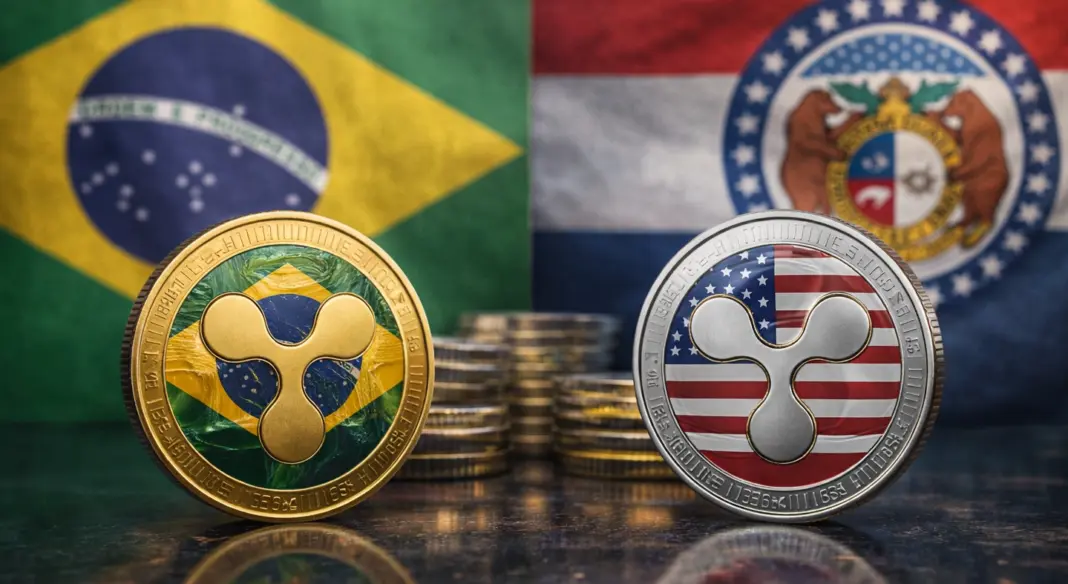

Picture two very different meetings happening on the same day. In São Paulo, a Brazilian bank’s treasury team is reviewing a slide deck from Ripple.
Cross‑border payments, on‑chain custody, prime brokerage, tokenization tools, and a dollar‑backed stablecoin called RLUSD, all wrapped in a “compliance‑first” pitch tied to Brazil’s new licensing regime.
Stay ahead in the crypto world – follow us on X for the latest updates, insights, and trends!🚀
In Jefferson City, Missouri lawmakers are debating House Bill 2080, which would let the state hold XRP, alongside BTC, ETH, SOL, and USDC, in a new digital‑asset reserve fund, subject to strict holding‑period and funding rules.
Both rooms are talking about the same token, but the contexts couldn’t be more different, and together they raise a bigger question: are we seeing a new phase of XRP adoption, or two live experiments in how far you can go with a still‑controversial asset while regulation catches up?
Brazil: Ripple builds a “compliance‑first” institutional hub
Ripple’s Brazil push is not about getting XRP listed on one more retail exchange. Company statements and regional coverage describe a full institutional platform rollout covering cross‑border payments, custody, treasury, and prime brokerage for banks, fintechs, and infrastructure providers.
Ripple Payments already supports same‑day USD transfers for local players like Banco Genial, while Braza Bank uses Ripple’s rails for FX settlement and to issue a real‑backed stablecoin on the XRP Ledger.
Custody and tokenization tools are being offered via Ripple Custody to institutions and RWA issuers such as CRX and Justoken, which are using the stack to tokenize commodities and other real‑world assets.
A key part of the strategy is regulatory alignment. Ripple is applying for a Virtual Asset Service Provider licence with Brazil’s central bank, anchoring its operations inside the country’s new digital‑asset framework rather than running everything cross‑border from offshore hubs.
At the same time, its RLUSD stablecoin, a USD‑backed token launched via its custody arm, has reportedly grown past 1.5 billion dollars in circulation, with adoption from major Brazilian exchanges and fintechs such as Mercado Bitcoin, Ripio, and Braza Bank as local demand for compliant dollar exposure rises.
Brazil’s financial ecosystem makes this more than a marketing play: the country has an advanced instant‑payments system, the PIX, a licensing regime for crypto providers, and banks already experimenting with tokenization and stablecoins, which means Ripple’s rails can, in principle, fade into the background as plumbing for cross‑border and RWA flows rather than remaining a speculative overlay.
Missouri's Cryptocurrency Strategic Reserve Fund HCS HB 2080 is moving "Do Pass" out of committee & headed to the full House floor as of mid-March 2026. Still a proposal, not law yet.
Missouri Digital Reserve Treasurer can accept, hold & invest in:$BTC$ETH$SOL$XRP$USDC… pic.twitter.com/PlBDJXpKAF
— 𝗕𝗮𝗻𝗸XRP (@BankXRP) March 16, 2026
Missouri: small allocation, big symbolism
Missouri’s move lives at the other end of the spectrum: small in scale, big in symbolism. House Bill 2080, which recently cleared a state House committee with a “do pass” recommendation, would create a Cryptocurrency Strategic Reserve Fund within the state treasury.
Drafts and commentary indicate the treasurer could accept and hold several digital assets financed by donations and grants rather than taxpayer money.
The bill sets a minimum five‑year holding period for reserve assets, effectively banning short‑term trading and framing any allocation as a long‑horizon position rather than an active speculative bet.
The state could work with U.S.‑based custodians, and would have to publish public reports on reserve composition and performance, bringing a degree of transparency that many private treasuries do not have.
It’s not law yet, the bill still needs full House and Senate approval, and a similar effort failed in the last year, but even advancing out of committee signals that some U.S. lawmakers are comfortable naming specific tokens, including XRP, as eligible reserve assets despite ongoing federal‑level debates.
That sits awkwardly against a backdrop where XRP’s U.S. regulatory story is only partially settled: courts have distinguished between different kinds of XRP sales, but questions about its long‑term classification, ETF prospects, and systemic role remain alive in Washington and among federal regulators.
Adoption vs regulation
Taken together, Brazil and Missouri highlight two distinct ways institutions “try on” a contentious asset. In Brazil, Ripple itself is being treated as infrastructure: banks, fintechs, and RWA issuers are plugging its payments, custody, and stablecoin tools into existing workflows, with the central bank supervising it as a VASP under Brazil’s crypto law.
The focus is on rails: can Ripple move dollars, real‑denominated assets, and tokenized instruments in a way that slots into Brazilian KYC, FX, and risk rules without creating new blind spots?
Missouri, by contrast, is treating XRP as a reserve component and political signal. A modest position in XRP and other tokens inside a state reserve fund is unlikely to transform Missouri’s finances, but it clearly sends a message about adopting crypto networks as part of public‑sector strategy and courting “pro‑innovation” credentials.
The main risk is less operational integration and more policy positioning: if the federal regulatory consensus shifts, for example, if future guidance leans harder toward treating certain tokens as unregistered securities, the state could find itself holding assets that suddenly sit in a murkier legal bucket.
Both approaches come with trade‑offs. Brazil’s bank‑grade deployment tests whether regulators are comfortable with a private company’s stack becoming part of critical payment and custody infrastructure.
Missouri’s bill tests how far a state can go in endorsing specific tokens before it collides with unresolved federal debates about classification, investor protection, and systemic risk.
What does this say about XRP adoption?
Zooming out, these moves point to at least three broader patterns in crypto adoption.
First, infrastructure often advances faster than narratives: in Brazil, Ripple is deepening partnerships with regulated players, scaling RLUSD, and chasing a VASP licence even while global arguments about XRP’s status continue.
For users of those rails, the practical questions are “does this clear compliance and does it work reliably,” not “is XRP winning the week on social media.”
Second, public‑sector adoption will be lumpy and political. Missouri’s proposal shows how crypto becomes a political object: picking XRP reflects local narratives, lobbying, and ideology as much as any spreadsheet‑based risk analysis.
Other states may copy or reject the model, federal agencies may quietly welcome state‑level experimentation as data, or see it as an unhelpful signal that complicates national policy.
Third, “enough certainty” is often the real threshold for experimentation. Neither Brazil’s central bank nor Missouri’s legislators are waiting for perfectly clean answers about XRP, they are acting on a view that there is now sufficient legal and operational footing to test it in specific roles, as institutional infrastructure in one case, as a small, long‑dated reserve asset in the other, while accepting that some regulatory risk remains.
The main point isn’t simply “XRP is winning” or “regulators don’t mind.” Adoption and regulation are now developing in parallel: banks and states are experimenting with live, structural use cases at the same time as taxonomies, court decisions, and licensing regimes are still being written.
When you see headlines about Ripple hubs in Brazil or reserve bills in Missouri, it’s worth asking two simple follow‑ups: is this a deep integration into financial plumbing or mainly a symbolic statement?
And if the regulatory weather changes, how easy or painful would it be for that institution to unwind the position? Those answers matter at least as much as the token’s price chart if you’re trying to understand what “adoption” really means.

Cryptocurrency and Web3 expert, founder of Kriptoworld
LinkedIn | X (Twitter) | More articles
With years of experience covering the blockchain space, András delivers insightful reporting on DeFi, tokenization, altcoins, and crypto regulations shaping the digital economy.
📅 Published: March 19, 2026 • 🕓 Last updated: March 19, 2026
✉️ Contact: [email protected]
Disclosure:This article does not contain investment advice or recommendations. Every investment and trading move involves risk, and readers should conduct their own research when making a decision.
Kriptoworld.com accepts no liability for any errors in the articles or for any financial loss resulting from incorrect information.
