

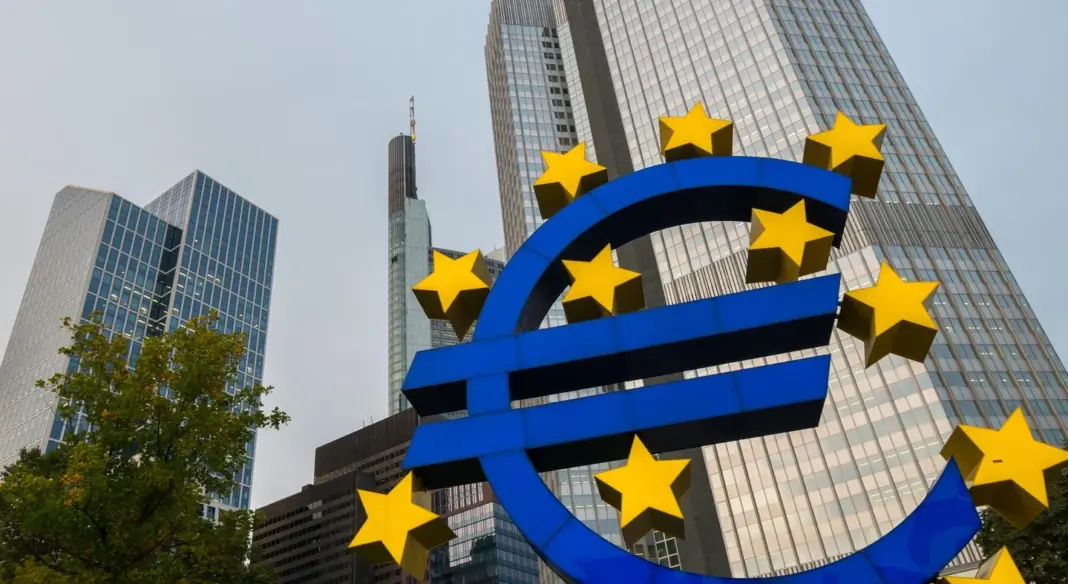

The European Central Bank is sending a fairly clear message to crypto: if your project is not actually decentralized, it may not stay outside regulation.
And if digital money is important enough to matter systemically, Europe would rather build it into official infrastructure. That is why two recent ECB-linked developments belong in the same conversation.
Stay ahead in the crypto world – follow us on X for the latest updates, insights, and trends!🚀
The DeFi side: the numbers behind the accusation
An ECB staff working paper published March 26 analyzed the governance structures of four major DeFi protocols, Aave, MakerDAO, Ampleforth, and Uniswap, using snapshot data from late 2022 and mid-2023.
The core finding is blunt: in all four protocols, the top 100 governance token holders control more than 80% of the total supply, with large shares of those tokens traceable to the protocols themselves, their associated treasuries, or centralized exchanges, Binance being the single largest identified exchange holder across all four.
Have you heard the crypto myth about decentralization? Well, this one is different. This is a venture capital and founder concentration problem wearing a DAO hat.
Voting power turns out to be even more concentrated than token ownership, because actual governance participation runs through delegates who accumulate proxy voting rights from passive holders. The top 20 voters in Ampleforth control 96% of proxy voting rights.
The top 10 in MakerDAO control 66%. The top 18 in Uniswap control 52%. The researchers also found that a meaningful share of those top voters, roughly one third, could not be publicly identified, which makes accountability both difficult and somewhat awkward to claim.
At Uniswap, the single largest governance participant in both snapshot periods was a16z, the venture capital firm.
Why this matters for regulation
The paper’s policy target is specific. MiCA exempts services provided in a “fully decentralized manner without any intermediary” from its core licensing requirements.
The ECB researchers argue that Aave, MakerDAO, Ampleforth, and Uniswap fall materially short of that standard given what the governance data actually shows, and they describe the decentralization argument for these protocols as “form over substance.”
The paper’s explicit goal is to help regulators identify “regulatory anchor points” in systems designed to avoid having a traditional issuer, CEO, or board.
One important caveat before the alarm bells ring: this is a working paper reflecting the views of its authors, not official ECB enforcement policy or a new rule.
The data snapshots are also from 2022 and 2023, meaning governance structures may have shifted. But as a regulatory signal, the publication still matters considerably.
The ECB is effectively building the intellectual scaffolding for a narrow interpretation of MiCA’s exemption, which means DeFi protocols that assumed they could stay outside European regulation may face a harder conversation than their branding suggested.
The digital euro side: banks as partners, not casualties
At the same time, the ECB is being careful not to antagonize the institutions it most needs to cooperate with.
As covered earlier this week, ECB Executive Board member Piero Cipollone told EU lawmakers the central bank expects to publish digital euro technical standards by this summer, so payment providers and merchants can start preparing their systems before any final issuance decision.
Cipollone’s messaging consistently frames the digital euro as shared public infrastructure that private financial institutions can build on and distribute, not a direct central bank product that competes with or replaces commercial banking relationships.
That is a deliberately strategic positioning. If banks see the digital euro as a tool they can integrate and distribute, they are more likely to become willing collaborators than resistant lobbying opponents.
Europe learned from earlier digital euro consultations that private sector buy-in is not optional, and the current framing reflects that.
The strategic picture
Taken together, the ECB’s moves describe a coherent regulatory strategy rather than two unrelated announcements.
The central bank is narrowing the space for DeFi actors to claim regulatory distance through decentralization language, while simultaneously widening the invitation for traditional financial institutions to participate in Europe’s official digital money layer. Europe is deciding which parts of crypto belong outside the system and which belong inside it.
For now, the bias is consistent. Projects claiming to be decentralized will face harder questions, while bank-linked digital infrastructure is being built into the tent.

Crypto market researcher and external contributor at Kriptoworld
Wheel. Steam engine. Bitcoin.
📅 Published: March 30, 2026 • 🕓 Last updated: March 30, 2026
✉️ Contact: [email protected]
Disclosure:This article does not contain investment advice or recommendations. Every investment and trading move involves risk, and readers should conduct their own research when making a decision.
Kriptoworld.com accepts no liability for any errors in the articles or for any financial loss resulting from incorrect information.
