

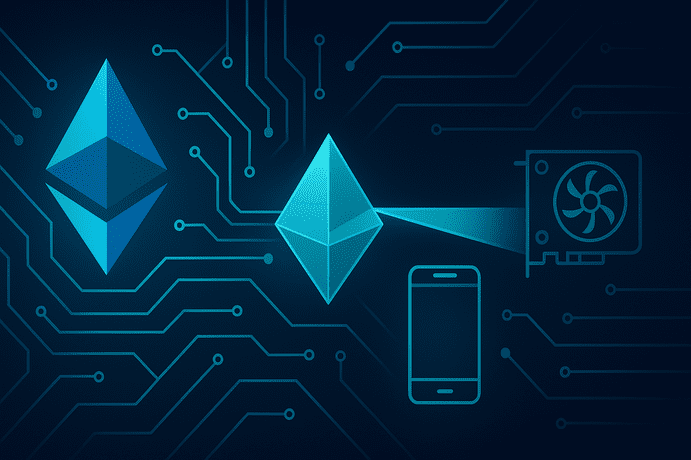

Brevis said Pico Prism, its zkEVM, proved 99.6 percent of Ethereum L1 blocks in real time. The team ran the test in under twelve seconds using consumer GPUs. The result placed real time proving beside block production speed.
Pico Prism used sixty four Nvidia RTX 5090 cards to generate zero knowledge proofs.
The setup showed that ZK proofs can run on retail hardware. As a result, block proving moved closer to broad replication.
Stay ahead in the crypto world – follow us on X for the latest updates, insights, and trends!🚀
Brevis added a target to reach 99 percent real time proving with fewer than sixteen RTX 5090 GPUs.
The goal puts consumer GPUs at the center of zkEVM proving. Therefore, the path to lower costs and wider access looks clearer.
Why real time proving matters
Today, validators re execute every transaction to verify Ethereum L1 blocks. That model raises hardware needs and slows throughput. Consequently, scaling hits a ceiling at the base layer.
Real time proving changes the workflow for validators. One prover creates a ZK proof of correct execution. Then every validator verifies that proof in milliseconds instead of re executing transactions.
This shift reduces duplication across the network. It also lowers the entry bar for nodes and strengthens decentralization. In turn, Ethereum L1 gains room to grow throughput without changing trust assumptions.
How Pico Prism achieves zkEVM speed
Pico Prism implements a zkEVM that generates validity proofs for live blocks. The prover keeps pace with block times to maintain real time proving. Meanwhile, proof verification stays fast for validators.
The system parallelizes proving tasks across consumer GPUs. With RTX 5090 cards, Pico Prism spreads the load and cuts latency. Additionally, the cluster design makes replication by other teams straightforward.
Brevis reported 99.6 percent real time proving under twelve seconds. That figure means ZK proofs arrived as fast as new blocks in most cases. Therefore, the zkEVM pipeline aligned with Ethereum L1 production cadence.
Path to 10,000 TPS on Ethereum
Once validators verify ZK proofs instead of re executing transactions, Ethereum L1 can raise throughput.
Proof verification costs far less than full re execution. As a result, headroom for 10,000 TPS increases.
Roadmap items support this direction. The Fusaka upgrade includes EIP 7825, which caps per transaction gas usage.
With subblocks, that gas cap enables more parallel proving and smoother real time proving on Ethereum L1.
Researchers and builders expect multiple teams to prove every L1 EVM block on clusters of sixteen GPUs drawing under ten kilowatts.
If that holds, proof generation and proof verification will stay within consumer GPU reach. Therefore, 10,000 TPS becomes a realistic milestone for the base layer.
Phone as a node and validator access
Lower proving costs also help light clients and small validators. If one prover supplies a validity proof, phones and laptops can verify it quickly. Thus, phone as a node becomes practical for Ethereum L1.
Pico Prism’s real time proving supports this model. ZK proofs arrive quickly, and verification remains lightweight.
Consequently, more participants can check the chain without specialized rigs.
As participation widens, decentralization benefits. More independent verifiers reduce reliance on a few large operators.
Meanwhile, Ethereum L1 keeps building toward 10,000 TPS with zkEVM real time proving, ZK proofs, and consumer GPUs at the core.
Disclosure:This article does not contain investment advice or recommendations. Every investment and trading move involves risk, and readers should conduct their own research when making a decision.
Kriptoworld.com accepts no liability for any errors in the articles or for any financial loss resulting from incorrect information.

Tatevik Avetisyan is an editor at Kriptoworld who covers emerging crypto trends, blockchain innovation, and altcoin developments. She is passionate about breaking down complex stories for a global audience and making digital finance more accessible.
📅 Published: October 16, 2025 • 🕓 Last updated: October 16, 2025
