

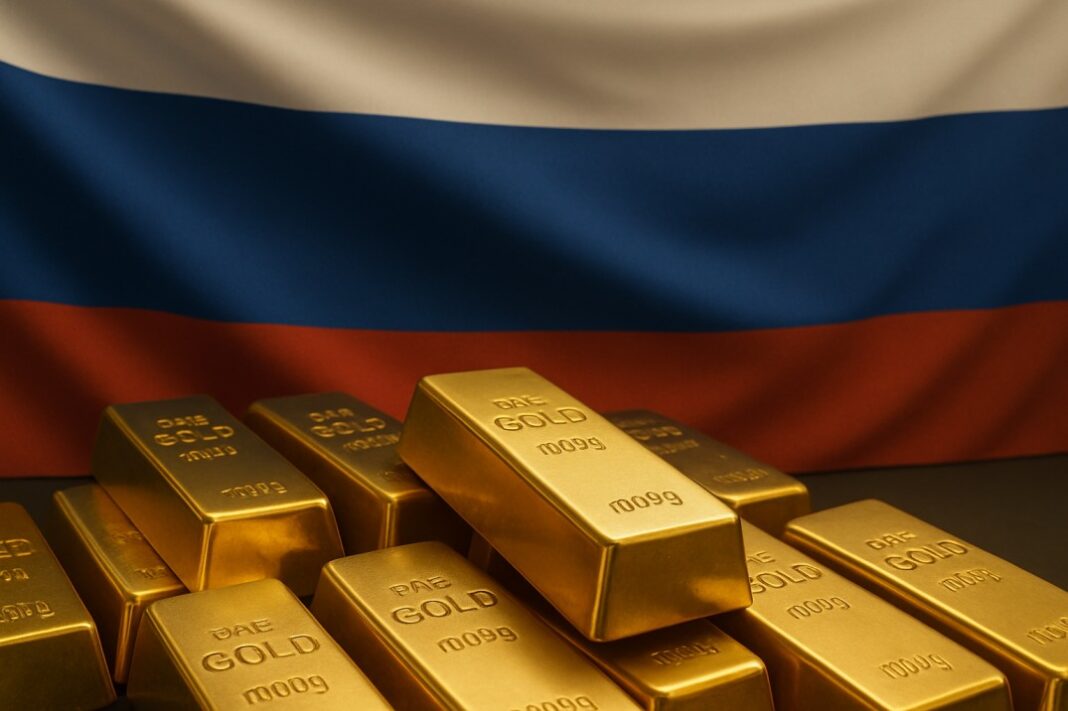

Russian gold reserves now stand at 310 billion dollars in gold, according to the Central Bank of Russia.
Gold forms a gold share 42.3 percent of total international reserves, which is one of the highest ratios in Russia’s modern history. The data place Russia gold reserves near half of the country’s official portfolio.
Stay ahead in the crypto world – follow us on X for the latest updates, insights, and trends!🚀
These figures show how Russian gold reserves moved toward assets that do not depend on foreign currencies.
The Central Bank of Russia lists gold, foreign cash, and securities as the main parts of its balance sheet. Within that mix, 310 billion dollars in gold now plays a central role.
The current level is also the highest gold share since the mid-1990s. At that time, gold already held a visible place in Russia gold reserves, but the weight later fell before rising again under today’s de-dollarization focus.
Russian Gold Reserves Rebound From 2 Percent Low
In 1993, shortly after the Soviet Union’s breakup, the gold share 42.3 percent today compares with a peak of 57 percent.
Back then, Russian gold reserves formed the majority of the country’s safety buffer. Later, policymakers reduced that dependence on the metal and shifted toward foreign currencies and bonds.
Around 2007, gold dropped to only 2 percent of Russia gold reserves. At that point, the Central Bank of Russia held almost all reserves in foreign cash and securities.
The metal played a small role, and the focus stayed on liquid dollar and euro assets.
From that low base, Moscow began to rebuild Russian gold reserves. Over the following years, the Central Bank of Russia added more bullion and reduced some foreign holdings.
As a result, the metal moved back toward the center of reserve management and reached the current gold share 42.3 percent.
De-Dollarization Push Reshapes Russia Gold Reserves
The rise in Russia gold reserves links directly to de-dollarization. After sanctions and asset freezes hit Russia’s overseas reserves, officials increased their focus on safe assets stored under domestic control. In this context, 310 billion dollars in gold represents both value and independence from foreign systems.
Gold does not rely on a foreign central bank or commercial custodian inside a jurisdiction that can apply new sanctions.
When the Central Bank of Russia holds bullion at home or in selected locations, it treats it as one of the key safe assets. Therefore, Russian gold reserves serve both financial and geopolitical aims.
At the same time, gold can be sold or swapped quickly in global markets. This liquidity means Russia gold reserves can be turned into foreign currency if needed, even while the country keeps pursuing de-dollarization and reduces long-term exposure to the U.S. dollar.
China, De-Dollarization, And The Wider Gold Shift
The trend in Russian gold reserves appears alongside similar moves by China. Public data show that China has cut some of its U.S. Treasury holdings while increasing official gold.
This pattern fits the broader de-dollarization narrative across several large economies.
Both Russia and China respond to rising U.S. debt levels and debates around the Federal Reserve and fiscal policy.
In this environment, gold becomes a shared choice among safe assets. It reduces reliance on any single foreign currency while keeping access to deep global markets.
Earlier reports on Russia gold reserves mentioned a value of about 207.7 billion dollars in gold. The current 310 billion dollars in gold number therefore marks a clear step up in both volume and price terms.
As long as sanctions and tensions remain part of Russia’s environment, the existing gold share 42.3 percent illustrates how strongly Russian gold reserves already reflect the ongoing de-dollarization path.
Disclosure:This article does not contain investment advice or recommendations. Every investment and trading move involves risk, and readers should conduct their own research when making a decision.
Kriptoworld.com accepts no liability for any errors in the articles or for any financial loss resulting from incorrect information.

Tatevik Avetisyan is an editor at Kriptoworld who covers emerging crypto trends, blockchain innovation, and altcoin developments. She is passionate about breaking down complex stories for a global audience and making digital finance more accessible.
📅 Published: December 8, 2025 • 🕓 Last updated: December 8, 2025
