



A federal judge in Connecticut has ordered the Connecticut Department of Consumer Protection (DCP) to pause its case against Kalshi.
The order tells the DCP to stop enforcement while the court reviews Kalshi’s request for protection.
Stay ahead in the crypto world – follow us on X for the latest updates, insights, and trends!🚀
The conflict began after the DCP sent cease and desist letters on Dec. 2 to Kalshi, Robinhood, and Crypto.com.
The DCP accused them of “conducting unlicensed online gambling, more specifically sports wagering, in Connecticut through its online sports event contracts.”
Kalshi responded the next day by suing the Connecticut Department of Consumer Protection in federal court.
It also filed a motion for a preliminary injunction to block Connecticut’s gambling laws from applying to its prediction markets while the case moves forward.
Judge Vernon Oliver ordered that the DCP must “refrain from taking enforcement action against Kalshi” for now.
He set Jan. 9 as the deadline for the DCP’s response and Jan. 30 for Kalshi’s further filings. The federal court will hold oral arguments in mid-February.
The current order only covers Kalshi. It does not address enforcement against Robinhood or Crypto.com under Connecticut gambling laws.
Kalshi Cites CFTC Jurisdiction in Connecticut Gambling Laws Dispute
In its filings, Kalshi points to its status as a designated contract market overseen by the Commodity Futures Trading Commission (CFTC).
It argues that its prediction markets are federally regulated derivatives, not gambling products under Connecticut gambling laws.
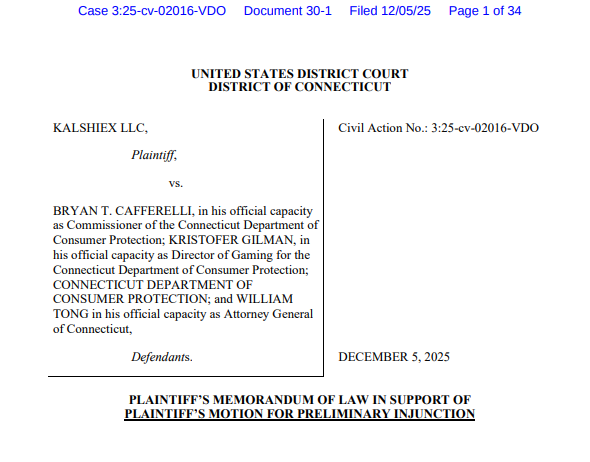
Kalshi’s motion says its event contracts “are lawful under federal law” and that its platform is under the CFTC’s “exclusive jurisdiction.”
An excerpt of the preliminary injunction motion on CourtListener frames the Connecticut Department of Consumer Protection action as conflicting with federal commodities law.
Kalshi began offering event contracts nationwide in January, including markets tied to sports and politics.
The DCP treats those sports-related prediction markets as unlicensed sports wagering inside Connecticut.
Kalshi argues that, because the CFTC regulates its designated contract market, Connecticut gambling laws should not reclassify those same products.
The federal court has not decided that question yet. Judge Vernon Oliver has only frozen enforcement by the Connecticut Department of Consumer Protection while he reviews Kalshi’s request for a longer injunction.
Kalshi Fights Gambling Laws in New York, Massachusetts and Other States
The Connecticut case is part of a wider clash between Kalshi and state gambling laws. The prediction markets platform is already in active disputes with several other US states.
In October, Kalshi sued the New York State Gaming Commission after it sent a cease and desist letter over alleged unlicensed sports wagering.
In September, the Massachusetts attorney general sued Kalshi in state court. Kalshi has asked that court to dismiss the Massachusetts case.
So far this year, Kalshi has also sued regulators in New Jersey, Nevada, Maryland, and Ohio, accusing them of regulatory overreach.
In each filing, Kalshi says state agencies are treating its prediction markets as gambling when they are, in its view, CFTC-regulated derivatives.
These legal fights come as Kalshi reports rising prediction markets activity. The platform logged 4.54 billion dollars in monthly trading volume in November.
Earlier this month, Kalshi closed a 1 billion dollar funding round at a reported 11 billion dollar valuation.
The combined cases in Connecticut, New York, Massachusetts, New Jersey, Nevada, Maryland, and Ohio all focus on the same core issue: how prediction markets like Kalshi fit between federal CFTC rules and state gambling laws.
Disclosure:This article does not contain investment advice or recommendations. Every investment and trading move involves risk, and readers should conduct their own research when making a decision.
Kriptoworld.com accepts no liability for any errors in the articles or for any financial loss resulting from incorrect information.

Tatevik Avetisyan is an editor at Kriptoworld who covers emerging crypto trends, blockchain innovation, and altcoin developments. She is passionate about breaking down complex stories for a global audience and making digital finance more accessible.
📅 Published: December 10, 2025 • 🕓 Last updated: December 10, 2025
