



A Senate housing bill now includes language that would block a US CBDC until December 31, 2030. The proposal would change the Federal Reserve Act and stop the Federal Reserve from issuing a central bank digital currency during that period.
Lawmakers placed the US CBDC ban near the end of the 300 page “21st Century ROAD to Housing Act” (HR 6644).
The Senate Committee on Banking, Housing, and Urban Affairs released the bill on Monday.
The Senate moved the bill forward on a procedural cloture vote of 84 6. That step limits debate and clears the way for full floor consideration.
US CBDC Ban Targets Federal Reserve Digital Dollar Issuance
Section 10 of the bill says the board of governors of the Federal Reserve System or a Federal Reserve bank “may not issue or create a central bank digital currency or any digital asset that is substantially similar” to a US CBDC.
The text also bars indirect issuance. It blocks a US digital dollar delivered “directly or indirectly through a financial institution or other intermediary.” That wording covers bank based distribution.
The proposed restriction includes a sunset clause. It expires on December 31, 2030, unless lawmakers pass new legislation to extend the US CBDC ban.
Stablecoin Exception Added Inside US CBDC Ban Language
The housing bill includes an exception for stablecoins. It says the Federal Reserve “shall not prohibit any dollar denominated currency that is open, permissionless, and private.”
The text also says it preserves the privacy protections of physical currency. That line links the US CBDC debate to cash style privacy standards.
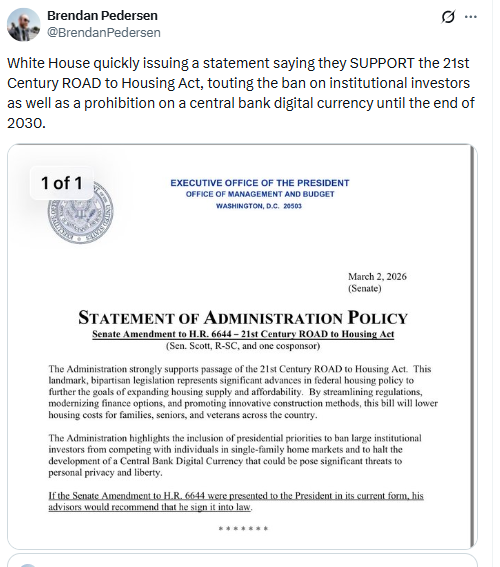
The White House issued a statement supporting the Act and opposing a US CBDC. It said a central bank digital currency could “pose significant threats to personal privacy and liberty.”
No CBDC Act and Anti CBDC Surveillance State Act Return in New Form
The housing bill revives language used in earlier US CBDC proposals. Those efforts moved as standalone bills, and then they stalled.
Senator Mike Lee introduced the “No CBDC Act” (S 464) in February 2025. The bill would have prohibited the Federal Reserve or the Treasury from issuing a central bank digital currency, but it did not advance.
Congressman Tom Emmer introduced the “Anti CBDC Surveillance State Act” (HR 1919) in June 2025. The bill passed a House vote on July 17, yet it has not passed full Senate approval.
The new approach ties the US CBDC ban to a major housing package. As a result, the issue now moves alongside broader banking and housing policy.
CBDC Tracker Shows Nigeria Jamaica Bahamas Live While Others Test
Outside the US, several countries already run a CBDC. The Atlantic Council CBDC tracker lists Nigeria, Jamaica, and The Bahamas as the only three countries with officially deployed CBDCs.
The tracker also says 49 countries are actively testing CBDCs. It lists China, Russia, India, and Brazil among the testing group.
Another 20 countries have CBDCs in development, while 36 remain in the research stage. In February, Joachim Nagel, the German central bank president, spoke about CBDC benefits for the European Union, which is in a pilot phase.
The Senate housing bill now puts the US CBDC issue back on the floor. The proposed US CBDC ban would last until 2030 if lawmakers pass the measure as written.
Disclosure:This article does not contain investment advice or recommendations. Every investment and trading move involves risk, and readers should conduct their own research when making a decision.
Kriptoworld.com accepts no liability for any errors in the articles or for any financial loss resulting from incorrect information.

Tatevik Avetisyan is an editor at Kriptoworld who covers emerging crypto trends, blockchain innovation, and altcoin developments. She is passionate about breaking down complex stories for a global audience and making digital finance more accessible.
📅 Published: March 3, 2026 • 🕓 Last updated: March 3, 2026
