



Most people fear smart‑contract hacks, but the bigger money is still being stolen the old‑fashioned way: through fear, urgency, and fake authority. That is the common thread between two new cases.
One in Murfreesboro, U.S., where residents lost nearly 4 million dollars to Bitcoin scams, and another in Hong Kong, where a 66‑year‑old retiree was drained for 840,000 dollars across three separate crypto frauds in just six months.
Stay ahead in the crypto world – follow us on X for the latest updates, insights, and trends!🚀
Murfreesboro: fear first, Bitcoin second
In Murfreesboro, Tennessee, police fraud detectives say dozens of residents, predominantly older adults, have lost nearly 4 million dollars in a scheme that has been running for months.
The mechanics are painfully familiar. Scammers call victims while impersonating local, state, or federal law enforcement, claim the victim has an outstanding arrest warrant, missed a grand jury summons, or is unknowingly caught up in a money laundering case, and then present themselves as the one person who can make the problem go away, if the victim pays immediately.
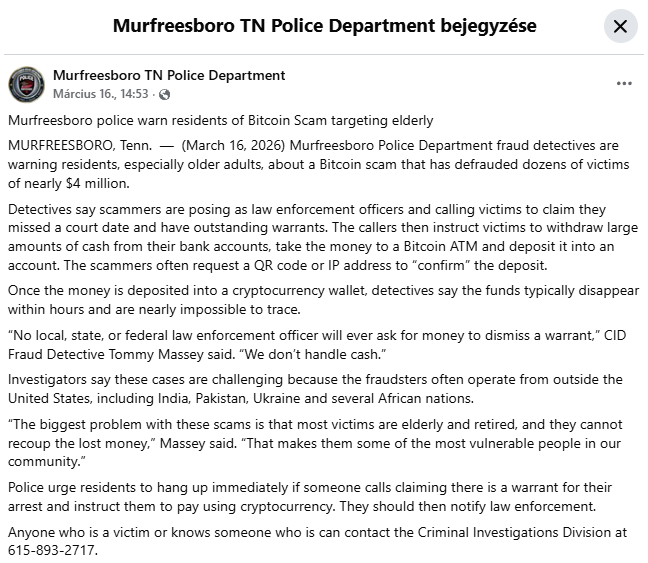
The payment method is almost always crypto. Victims are directed to Bitcoin ATMs to convert cash into cryptocurrency, handed QR codes to send funds to, or in some cases instructed to give cash directly to couriers.
Fraud detective Tommy Massey told local outlets that once the funds move, they are typically gone within 72 hours, often transferred overseas, and the rise of AI tools has made it considerably easier for scammers to sound authoritative and personalized. The Bitcoin part is almost secondary.
The real weapon is psychological pressure, and the artificial urgency that makes otherwise careful people act without stopping to check.
Hong Kong: one victim, three scams
The Hong Kong case is even more revealing because it shows how scammers reuse victims rather than move on once the first fraud succeeds.
Hong Kong police say the 66‑year‑old retiree was contacted on WhatsApp by individuals posing as crypto investment experts and lost 6.6 million Hong Kong dollars, roughly 840,000 dollars, across three linked frauds.
The pattern escalated step by step. First, a “crypto expert” convinced the victim to put money into an investment that then disappeared.
Then a second fraudster appeared and promised to recover those lost funds, but only after receiving an upfront fee.
Then a third scammer arrived claiming the original investment and the supposed recovery were both sitting in a locked account, and could only be “unlocked” with one more large payment.
This is what makes the case a particularly useful warning. The scam did not end after the first loss, instead, it turned into a pipeline.
Once the victim had shown willingness to transfer funds and respond to urgency, her details became more valuable to fraud networks, not less, and each subsequent fraud was built around specific information from the previous one, making it sound more plausible, not less.
Why repeat targeting keeps working
These two cases are not isolated incidents. Chainalysis estimates that crypto scams stole a record 17 billion dollars in 2025, with impersonation tactics and AI‑enabled personalization identified as the key drivers of the surge.
Victims who respond to one pitch can end up on circulated lists, with their details sold or shared among fraud groups offering “recovery” services, fake compliance assistance, or new “expert” investment opportunities.
That is why the second scam so often arrives dressed as the solution to the first: it is built around real information from the earlier fraud, which makes it feel credible when it should instead be the clearest possible red flag.
What to do instead
For retail users, the practical rules are blunt but effective. Never move money based on an unsolicited call, WhatsApp message, or email, regardless of how official the caller sounds.
Never send funds to a “safe wallet” or QR code provided by someone claiming to protect your money.
Never pay an upfront fee to “recover” lost crypto, that is almost always scam number two. Verify every claim through official channels you find yourself, not through numbers or links provided by the caller.
Crypto scams often have very little to do with crypto technology. They work because people panic, trust the wrong voice, and then get targeted again once their name enters the system.
That’s basic human psychology. The biggest consumer protection rule in crypto is still the oldest one in finance: if someone creates urgency and instructs you to move money immediately, stop, because that pressure is almost always the scam itself.

Cryptocurrency and Web3 expert, founder of Kriptoworld
LinkedIn | X (Twitter) | More articles
With years of experience covering the blockchain space, András delivers insightful reporting on DeFi, tokenization, altcoins, and crypto regulations shaping the digital economy.
📅 Published: March 23, 2026 • 🕓 Last updated: March 23, 2026
✉️ Contact: [email protected]
Disclosure:This article does not contain investment advice or recommendations. Every investment and trading move involves risk, and readers should conduct their own research when making a decision.
Kriptoworld.com accepts no liability for any errors in the articles or for any financial loss resulting from incorrect information.
