

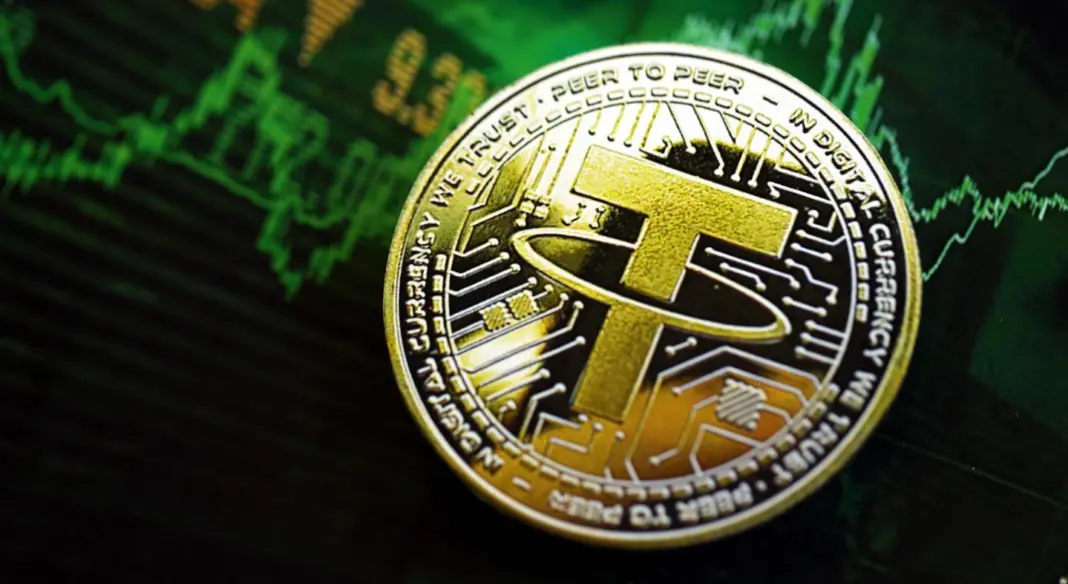

For a long time, crypto firms could treat compliance as a drag on growth. That is getting harder to do now.
Tether’s latest moves suggest that in the next cycle, credibility may matter as much as scale.
Stay ahead in the crypto world – follow us on X for the latest updates, insights, and trends!🚀
But OKX’s careful stance on public markets shows that not every major exchange wants to play the same game, or on the same timeline.
Tether’s shift
The KPMG engagement is the clearest signal yet that Tether is attempting to close the largest remaining credibility gap in its business.
The Financial Times identified KPMG, one of the world’s four largest professional services networks, as the firm selected to carry out what Tether’s own CFO Simon McWilliams described as “the biggest ever inaugural audit in the history of financial markets”.
A full financial statement audit of approximately $185 billion in USDT reserves.
That is a significant step up from the quarterly attestation process the company has relied on for years, which critics have long argued gave investors a narrower and less verifiable picture of the reserve structure.
The PwC engagement is what makes this more than a reputationally convenient announcement.
Having a second Big Four firm come in specifically to prepare internal controls and systems ahead of the KPMG review suggests the process is operationally demanding.
Not a checkbox exercise, but an effort to make the company genuinely legible to institutions that care about audit readiness, documentation trails, and the quality of financial controls, not just high-level reserve figures.
The timing has a clear commercial dimension: the news outlets previously reported that Tether faced hesitation from potential investors in a $15–20 billion fundraising round at a $500 billion valuation, with concerns focused on pricing and regulatory risk.
Building a credible audit record is a logical prerequisite for making that conversation move forward.
That does not mean every historical question around Tether’s reserves disappears the moment an audit process begins.
An engagement is not a completed opinion, and the scope and findings will matter as much as the announcement itself.
But it does mean the company is now spending real money and management attention to fit the expectations of traditional finance rather than continue arguing those expectations are misplaced.
More than defense
What makes the story more interesting is that Tether is not only defending its stablecoin franchise while it undergoes scrutiny.
It is also expanding into adjacent tokenized assets in parallel. Tether Gold, XAUT launched on BNB Chain on March 26, giving Binance’s massive user base access to tokenized gold exposure through one of the exchange ecosystem’s broadest spot trading menus, with pairs against USDT, BTC, USDC, and other assets.
The integration uses the USDt0 network architecture, which is designed to enable unified liquidity across more than twelve chains, so the BNB Chain rollout is not just adding one more venue, it is connecting Tether Gold into a multi-chain liquidity layer that spans most of the major blockchains where retail and institutional demand currently lives.
The tokenized gold market context is striking. The category is approaching $5.3 billion in total market capitalization, with XAUT accounting for roughly $2.5 billion of that total, about 60% of the global gold-backed stablecoin market according to Reuters reporting earlier this year, and Paxos Gold sitting close behind.
Tether has also invested $150 million to acquire a 12% stake in Gold.com, a move designed to further expand the gold issuance ecosystem around XAUT.
So while the company is pushing to become more institution-friendly on the audit and transparency side, it is simultaneously broadening the set of onchain products through which it can capture demand from a gold market that has been performing exceptionally well into 2026.
OKX as the contrast
OKX offers a useful counterpoint. OKX President Haider Rafique said this week that the exchange would not rush into public markets and would only pursue a listing “when we’re confident we can create sufficient shareholder value”.
This statement is making the case that a weak listing, one where early shareholders see returns of negative 50% or worse, could damage not just OKX but the broader crypto industry’s relationship with public capital markets.
Rafique framed the choice as a discipline question rather than a retreat, saying management is thinking about building the company over 20 to 30 years rather than optimizing for a near-term listing window.
That is a notably different posture than Tether’s, and the contrast is instructive.
Tether is spending money on two Big Four firms and a $150 million strategic investment to become more auditable, more expansive, and more institutionally acceptable at a moment when it is actively trying to raise billions and enter the U.S. market.
OKX is signaling that public-market visibility is optional, potentially premature right now, and worth deferring unless the economics clearly support it.
The recent $505 million DOJ settlement and subsequent U.S. relaunch gives OKX plenty of operational rationale for caution. Rebuilding regulatory standing is a different kind of credibility project than preparing for an IPO.
What this means
Connecting the dots, the two stories point toward the same underlying shift.
Crypto competition is starting to hinge less on who can grow the fastest in a permissive environment and more on who can survive sustained contact with auditors, regulators, and mainstream capital allocators without losing the operational momentum that made them valuable in the first place.
In that environment, compliance is becoming part of the product. A signal to institutional counterparties, potential fundraising partners, and regulators about whether a firm is serious enough to operate at the scale it is claiming.
Tether is trying to mature without decelerating its expansion. OKX is trying to expand without being forced into a public-market mold before the conditions are right.
The firms that win the next phase may simply be the ones that know which kind of seriousness their specific business model actually requires, and start doing the work before they are forced to.

Crypto market researcher and external contributor at Kriptoworld
Wheel. Steam engine. Bitcoin.
📅 Published: March 28, 2026 • 🕓 Last updated: March 28, 2026
✉️ Contact: [email protected]
Disclosure:This article does not contain investment advice or recommendations. Every investment and trading move involves risk, and readers should conduct their own research when making a decision.
Kriptoworld.com accepts no liability for any errors in the articles or for any financial loss resulting from incorrect information.
