



Prediction markets, bets on real-world events like elections, sports, or economic outcomes, are heating up, and the CFTC wants in.
The agency is gearing up for imminent rulemaking that could reshape how these platforms operate, especially in crypto where they’re blending with DeFi and onchain betting.
Stay ahead in the crypto world – follow us on X for the latest updates, insights, and trends!🚀
This is about where derivatives meet decentralized tech, and who gets to set the rules.
What prediction markets actually are (and why they matter)
At their core, prediction markets let people wager on yes/no outcomes, will Trump win 2028? Will inflation hit 3%?
The price of the contract reflects crowd wisdom: if “yes” trades at $0.75, the market thinks there’s a 75% chance.
Platforms like Polymarket have exploded in popularity, with billions in volume on major events. Crypto makes them efficient: low fees, instant settlement, borderless access.
But the CFTC sees them as derivatives, futures-like instruments, and wants to bring them under its umbrella.
The agency’s push stems from the GENIUS Act and broader market structure bills. Prediction markets are not new, but crypto versions are thriving.
The CFTC’s concern: without rules, they risk manipulation, money laundering, or systemic spillovers if big bets go wrong. The upcoming rules could require registration, reporting, or even bans on certain contracts.
How this fits crypto’s regulatory tightrope
This is classic TradFi meeting DeFi.
Prediction markets onchain offer transparency and speed traditional ones can’t match, Polymarket settled over $1B on the 2024 election alone.
But regulators see red flags: no KYC on some platforms, potential for insider trading, and overlap with gambling laws.
The CFTC already oversees commodity futures, prediction markets on events like weather or politics could fall under that if they’re “event contracts.”
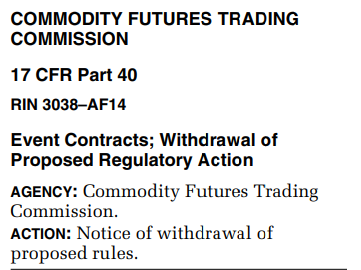
Source: CFTC.gov
It’s part of a bigger trend. The Clarity Act debates stablecoin yields, GENIUS Act shapes digital asset classification, now prediction markets are next.
If the CFTC clamps down, platforms might move offshore (Singapore, Dubai) or pivot to non-financial events. If it allows regulated versions, institutions could enter, bringing liquidity but also compliance costs.
Derivatives meet decentralization
Prediction markets bridge gambling, forecasting, and finance. In TradFi, they’re niche (Kalshi got CFTC approval for election bets). In crypto, they’re mainstream, Polymarket’s volume rivals some centralized exchanges.
The CFTC’s move could force a fork: regulated platforms for U.S. users with KYC and reporting vs. decentralized ones for the rest of the world.
This matters because prediction markets are ’truth machines’, they aggregate info better than polls sometimes. But without rules, they risk becoming manipulation tools or shadow banking.
The outcome decides if crypto gets a seat at the derivatives table or stays in the gray zone.
What this means in practice
Regulated markets could bring legitimacy and institutional money, boosting liquidity and accuracy.
Heavy rules might kill innovation or push activity offshore, fragmenting the space. Retail users lose easy access if KYC becomes mandatory, while DeFi purists see another centralization creep.
The CFTC’s prediction market rules could be the next big test for crypto’s regulatory fit.
Will they tame the frontier or push it underground? We’ll see.

Crypto market researcher and external contributor at Kriptoworld
Wheel. Steam engine. Bitcoin.
📅 Published: February 16, 2026 • 🕓 Last updated: February 16, 2026
✉️ Contact: [email protected]
Disclosure:This article does not contain investment advice or recommendations. Every investment and trading move involves risk, and readers should conduct their own research when making a decision.
Kriptoworld.com accepts no liability for any errors in the articles or for any financial loss resulting from incorrect information.
