

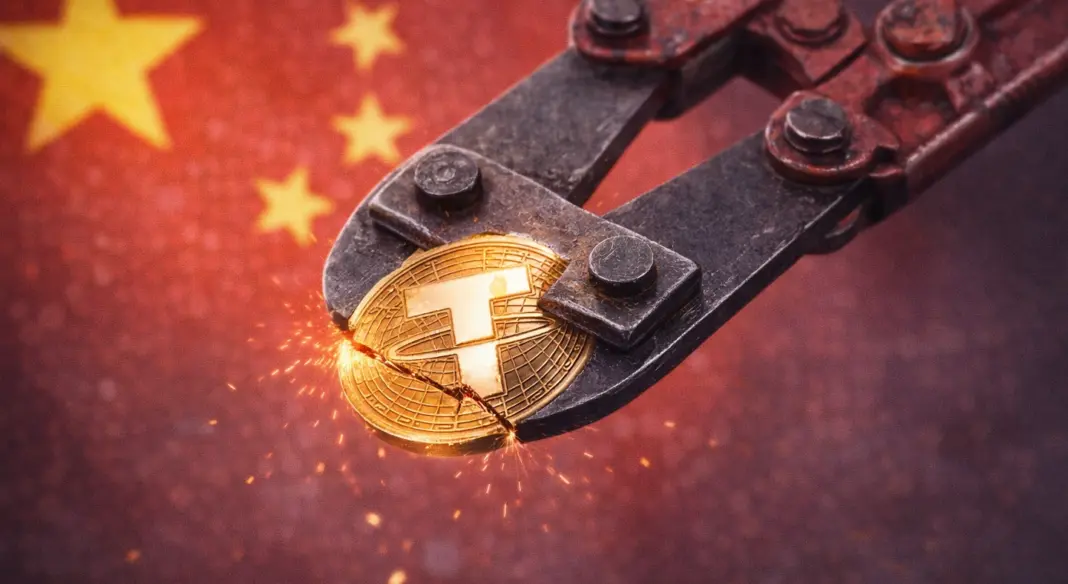

China tokenization ban signals a deeper split in how states approach digital money and asset issuance.
Chinese authorities have prohibited private firms from issuing stablecoins and tokenized real-world assets, or RWAs, according to recent reporting.
Stay ahead in the crypto world – follow us on X for the latest updates, insights, and trends!🚀
The decision targets issuance and infrastructure, and it defines who is allowed to create money-like instruments and under what authority.
That scope matters, because it places tokenization squarely inside monetary governance rather than treating it as a neutral technology layer.
In effect, China drew a boundary around financial infrastructure.
What the China tokenization ban actually covers
The restriction focuses on two areas, stablecoins and real-world asset tokenization.
Stablecoins function as privately issued digital money, while RWAs convert claims on physical or financial assets into programmable instruments. Both sit close to settlement, payments, and capital formation.
From Beijing’s perspective, these are not peripheral innovations. They intersect directly with state control over currency and asset representation.
Allowing private entities to issue tokenized alternatives introduces parallel systems that are difficult to supervise and even harder to unwind.
That is why the line was drawn at issuance, not at ownership or abstract trading activity.
Why stablecoins and RWAs triggered the response
Control over money and asset issuance has historically been a core state function.
Tokenization changes how quickly value moves, how claims are represented, and who sets the rules.
Stablecoins and RWAs compress those functions into software-driven rails that operate outside traditional hierarchies.
For Chinese regulators, this raises a sovereignty question rather than a market-efficiency debate.
The concern is not innovation speed, but authority and reversibility. That framing explains why tokenization drew attention while other crypto activities did not.
How this differs from Western regulatory paths
In the U.S. and Europe, tokenization is increasingly treated as financial infrastructure. Stablecoins are discussed as payment tools.
RWAs are framed as efficiency upgrades. Regulators focus on reserves, disclosure, custody, and risk controls rather than outright bans.
China’s approach follows a different logic. Tokenization is viewed as a monetary risk that needs containment at the infrastructure level. Governance comes before experimentation, and authority comes before efficiency.
This divergence reflects political and monetary priorities, not technical disagreement.
What the China tokenization ban means for Asia
China’s stance shapes the regional answers, because other Asian jurisdictions are already experimenting with regulated stablecoins and tokenized assets.
China’s decision sharpens those contrasts. When infrastructure doors close in one market, activity migrates toward jurisdictions with clearer or more permissive frameworks.
That local movement does not halt global adoption. This is how regional crypto ecosystems begin to diverge.
Why retail investors should pay attention
Global adoption does not happen as a single wave.
It passes through political filters. Monetary systems fragment when incentives and governance models differ. China’s decision highlights how sharply those lines can be drawn.
Some regions will integrate tokenization into their financial systems, while others will fence it off. That divergence affects where products launch, where liquidity forms, and how access develops.
Understanding those boundaries helps explain why crypto markets look different depending on geography.
Parallel stories
China tokenization ban is not a headline about enthusiasm rising or falling.
It reflects how tokenization sits at the intersection of technology and power, and different states will make different calls.
Global crypto adoption is not one single story, but many stories, happening all at once, in parallel.

Crypto market researcher and external contributor at Kriptoworld
Wheel. Steam engine. Bitcoin.
📅 Published: February 8, 2026 • 🕓 Last updated: February 8, 2026
✉️ Contact: [email protected]
Disclosure:This article does not contain investment advice or recommendations. Every investment and trading move involves risk, and readers should conduct their own research when making a decision.
Kriptoworld.com accepts no liability for any errors in the articles or for any financial loss resulting from incorrect information.
