

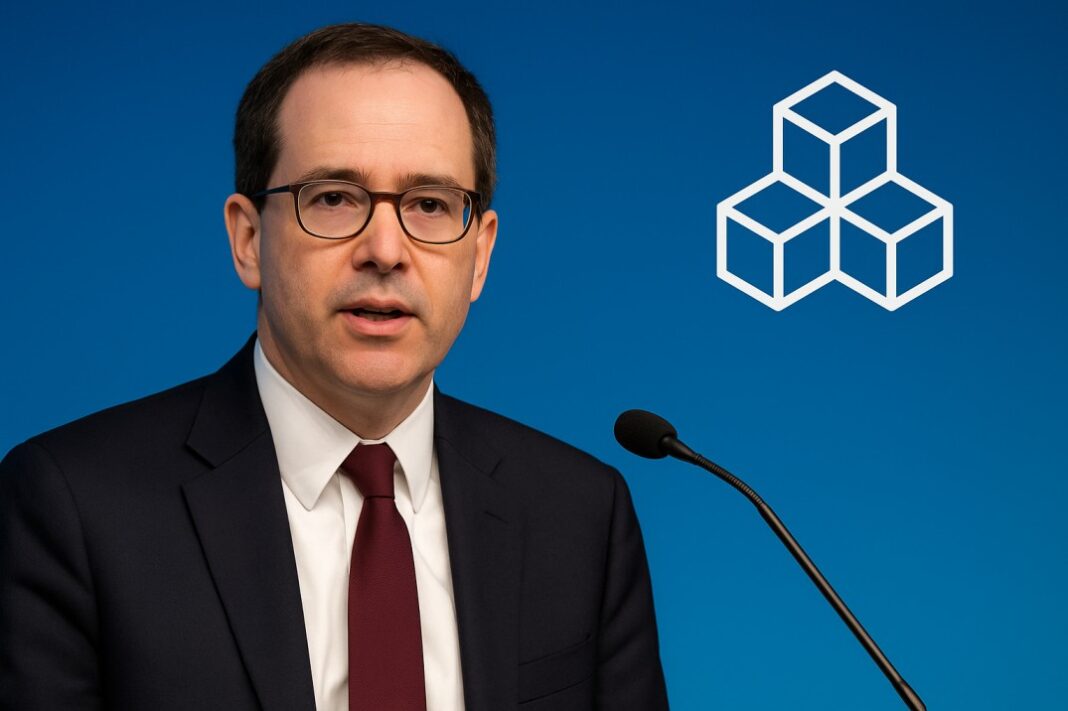

United States OCC chief Jonathan Gould said there is “no justification” for treating crypto banks and digital assets more harshly than traditional institutions.
He spoke on Monday at the 2025 Blockchain Association Policy Summit, where he outlined how the banking system can supervise digital asset activity under existing rules.
Stay ahead in the crypto world – follow us on X for the latest updates, insights, and trends!🚀
Gould said crypto companies that apply for a U.S. federal bank charter should be treated like any other financial institution.
He noted that many applicants in the digital and fintech sectors look new on the surface, yet the underlying services are familiar to supervisors.
“There is simply no justification for considering digital assets differently,”
Gould said. He pointed out that custody and safekeeping services already happen electronically inside the banking system, and have done so “for decades.”
He also warned against freezing banks inside outdated models.
“It is important that we do not confine banks, including current national trust banks, to the technologies or businesses of the past,”
he said. In that context, he framed blockchain as a new tool that can still sit under the same prudential standards.

From his view, the OCC can apply long-standing safety and soundness rules to digital assets, as long as crypto banks operate inside a chartered and supervised structure.
That way, the regulator can monitor risk and still allow new activities to develop inside the banking system.
OCC, Crypto Banks And The Federal Charter Debate
The OCC currently supervises only two crypto banks with national trust charters. Anchorage Digital has held its federal charter since 2021, and Erebor received a preliminary national trust bank charter in October.
Both operate as trust banks focused on digital assets under the same primary regulator that oversees large national banks.
Gould said this experience gives the OCC a direct view into how digital asset custody, security, and compliance work inside a regulated bank charter.
The agency has supervised a “crypto-native national trust bank” for years, which he presented as evidence that the framework already reaches digital assets.
So far this year, the OCC has received 14 applications to start a new bank, according to Gould. He said that figure is almost equal to the number of similar applications the agency saw across the previous four years.
Some of the 2025 applicants are “entities engaged in novel or digital asset activities,” he noted, which keeps crypto banks and fintech firms in the middle of the charter debate.
Gould said chartering helps the banking system keep pace with changes in finance and support the broader economy.
For that reason, he argued that entities working with digital assets and other new technologies “should have a pathway to become federally supervised banks.”
In his view, that path should look consistent with how other institutions enter the system.
Under that approach, crypto banks would move into the same framework as national banks, rather than operate in a separate lane.
The OCC would then supervise them as federally supervised banks, applying its normal tools to balance innovation, risk management, and consumer protection.
Digital Assets, Bank Charters And Supervision Under The OCC
Gould also addressed concerns from existing banks and trade groups about bringing digital assets fully inside the chartered banking system. Some of these organizations question whether the OCC can adequately oversee crypto banks and new activities linked to blockchain.
He said such concerns could slow or reverse changes that might improve services for bank customers and local economies.
At the same time, he stressed that the OCC has already built a track record supervising a crypto-focused national trust bank and studying digital assets across its portfolio.
According to Gould, the regulator now hears from existing national banks “on a near daily basis” about their own projects involving digital assets.
These include internal initiatives, new custody offerings, and payment experiments that use blockchain inside chartered institutions.
That activity shows that digital assets are no longer limited to specialist firms seeking a bank charter for the first time.
Gould said all of this strengthens his confidence in the OCC’s ability to supervise both new entrants and new activities by existing banks.
He emphasized that oversight must stay “fair and even-handed” across crypto banks, traditional lenders, and other federally supervised banks that handle digital assets.
Disclosure:This article does not contain investment advice or recommendations. Every investment and trading move involves risk, and readers should conduct their own research when making a decision.
Kriptoworld.com accepts no liability for any errors in the articles or for any financial loss resulting from incorrect information.

Tatevik Avetisyan is an editor at Kriptoworld who covers emerging crypto trends, blockchain innovation, and altcoin developments. She is passionate about breaking down complex stories for a global audience and making digital finance more accessible.
📅 Published: December 9, 2025 • 🕓 Last updated: December 9, 2025
