



Crypto derivatives activity jumped in 2025 as onchain perpetual futures moved into a central role, according to Coinbase researcher David Duong.
He said traders shifted behavior, and decentralized venues captured a larger share of the market.
Stay ahead in the crypto world – follow us on X for the latest updates, insights, and trends!🚀
By late 2025, decentralized exchanges processed more than $1 trillion in monthly perpetual futures volume, highlighting the scale of crypto derivatives activity tied to onchain perpetual futures. Duong shared the data point in a Monday post on X.
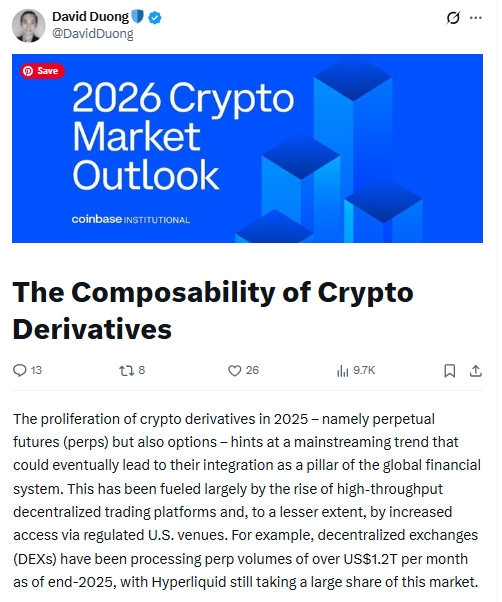
Duong linked the rise in onchain perpetual futures to a weak spot cycle. He said the absence of a traditional altcoin season pushed traders toward leverage, which lifted crypto derivatives activity and perpetual futures volume.
Onchain perpetual futures expand as leverage replaces spot rotation
Onchain perpetual futures are perpetual futures contracts that let traders take leveraged exposure without an expiry date.
These contracts track price moves while allowing traders to post smaller capital compared with full spot exposure.
Duong said the “unprecedented degree of leverage” available in onchain perpetual futures helped drive demand.
He described how leverage let traders amplify exposure using relatively small amounts of capital, which increased crypto derivatives activity.
He also argued that DeFi perpetual futures now sit deeper inside decentralized markets.
“Nevertheless, we think perpetual futures are evolving beyond isolated, high-leverage trading vehicles and are becoming core, composable primitives within DeFi markets,”
David Duong wrote.
Hyperliquid and Aster push onchain perpetual futures into the lead
Duong said decentralized platforms drove much of the growth in onchain perpetual futures, and he pointed to Hyperliquid and Aster as key venues.
Their activity aligned with the broader rise in perpetual futures volume across decentralized trading.
Hyperliquid launched its onchain perpetual exchange in late 2023. It gained broader traction in 2024 after adding spot trading, which expanded participation and supported higher crypto derivatives activity.
In July, DeFiLlama data showed Hyperliquid processed about $319 billion in trades for the month.
That record month highlighted how quickly an onchain perpetual exchange can scale during periods of heavy onchain perpetual futures demand.
Lighter funding and DeFiLlama data show a tighter onchain perpetual futures race
Competition in onchain perpetual futures intensified in September.
Shortly after its token generation event and launch, Aster briefly topped decentralized perp rankings with nearly $36 billion in 24-hour trading volume, accounting for more than half of total perp DEX activity.
In November, Lighter added another datapoint to the onchain perpetual futures cycle.
The onchain perpetual exchange was founded in 2022 by tech entrepreneur Vladimir Novakovski, and it raised $68 million after the launch of its public mainnet.
Over the past 30 days, DeFiLlama showed onchain perpetual futures generated about $972 billion in trading volume.
In that same window, Lighter led with about $203 billion, followed by Aster at roughly $171.8 billion, and Hyperliquid with about $160.6 billion, according to DeFiLlama.
Onchain perpetual futures could extend into tokenized stock perps, Duong says
Duong said equity perpetual futures could become a next growth area for onchain perpetual futures.
He linked that idea to tokenized stock derivatives, which could extend crypto derivatives activity beyond digital assets.
He said tokenized stock perps could combine crypto’s 24/7 access and leverage with demand for exposure to major U.S. equities outside traditional market hours.
He framed the concept as an extension of the same market mechanics that lifted perpetual futures volume in 2025.
The shift kept focus on infrastructure and trading behavior. Duong’s framing also kept attention on DeFi perpetual futures as building blocks, rather than isolated contracts, as onchain perpetual futures continued to pull volume from traditional venues.
Disclosure:This article does not contain investment advice or recommendations. Every investment and trading move involves risk, and readers should conduct their own research when making a decision.
Kriptoworld.com accepts no liability for any errors in the articles or for any financial loss resulting from incorrect information.

Tatevik Avetisyan is an editor at Kriptoworld who covers emerging crypto trends, blockchain innovation, and altcoin developments. She is passionate about breaking down complex stories for a global audience and making digital finance more accessible.
📅 Published: December 30, 2025 • 🕓 Last updated: December 30, 2025
