

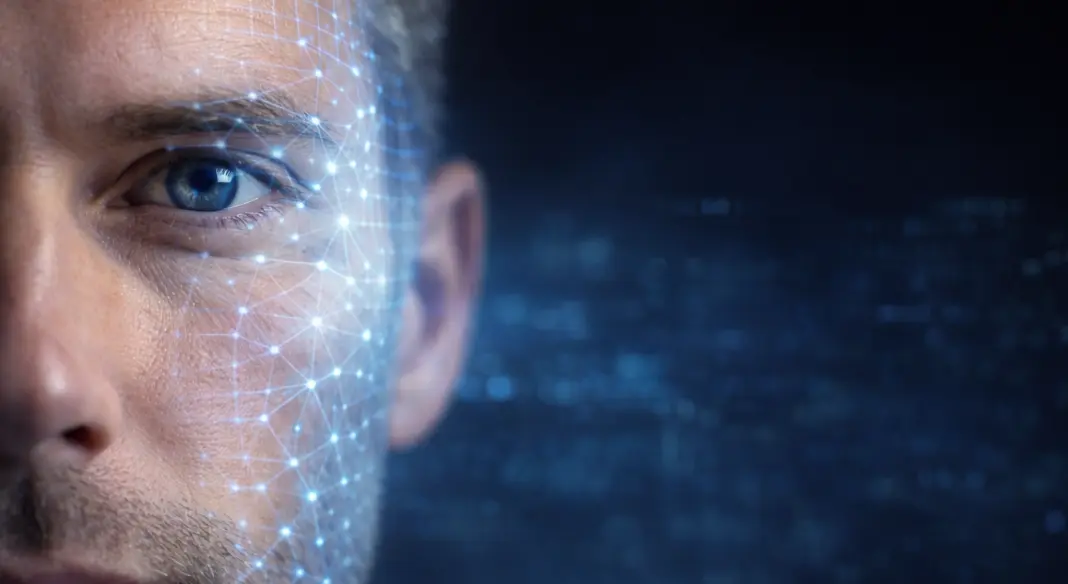

The “Dead Internet Theory,” the idea that most online interaction is already bots talking to bots, has moved from a fringe conspiracy to a measurable financial reality.
According to the latest TRM Labs 2026 Crypto Crime Report, AI-enabled scams skyrocketed by 500% in 2025, contributing to a record $158 billion in illicit on-chain flows.
Stay ahead in the crypto world – follow us on X for the latest updates, insights, and trends!🚀
It is against this backdrop of “industrial-scale” fraud that OpenAI’s reported move into biometric social media starts to look less like an expansion and more like a defensive perimeter.
The news, first broken by Forbes, that Sam Altman’s firm is building a “humans-only” X rival using Worldcoin’s Orbs and Apple’s Face ID signals the end of the pseudonymous era.
We are entering the age of the Biometric Firewall.
The $158 Billion Identity Crisis
The TRM Labs data is the “why” behind the “what.” When illicit volume hits nearly $160 billion, the cost of “free and open” platforms becomes too high for the global economy to ignore.
Fraudsters are now using large language models to automate trust at scale, running thousands of perfectly articulated romance and investment scams simultaneously.
In this environment, a username and a password are useless. Even two-factor authentication can be bypassed by AI-generated deepfakes.
The only thing an AI cannot (yet) convincingly replicate in the physical world is a hardware-verified iris scan or a 3D facial map.
The Rise of the “Verified” Blue Check
Remember the chaos when X first started selling blue checks? The intent was to solve the “impersonation” problem, but the execution turned it into a vanity metric.
OpenAI and Worldcoin are attempting to do what Elon Musk couldn’t, and make verification a technical requirement rather than a status symbol.
This is reminiscent of the transition from “open” email to the spam-filtered world of the early 2010s.
We used to accept that anyone could email anyone, then, the noise became so loud that we had to build massive, centralized gatekeepers (think Gmail, Outlook) just to keep our inboxes usable.
Biometric social media is the 2026 version of that gatekeeper.
The Altman Vertical
OpenAI creates the most powerful AI in the world (the “bot“). Worldcoin provides the most robust way to prove you aren’t an AI (the “shield“).
By launching a social network that requires the shield to protect against the bot, Altman is essentially building both the problem and the solution.
This creates a vertical monopoly on “Humanity.”
If OpenAI’s platform becomes the only place on the internet where you can be 100% sure you are talking to a person, then the biometric data held by Worldcoin and Apple becomes the most valuable commodity in the digital economy. Your uniqueness.
Privacy vs. The Humanity Check
The weird part is that the very people who claim to hate AI-generated spam are often the ones most terrified of biometric scanning.
We are caught in a pincer movement. On one side, if we don’t verify our identity, the internet becomes a sewer of AI-driven fraud.
On the other, if we do verify, we hand over our most intimate biological markers to a few massive corporations.
The TRM Labs report suggests that “privacy-preserving” technology is being outpaced by “crime-enabling” technology.
This suggests that the market will eventually choose safety over privacy. Most users will trade an iris scan for an internet experience that isn’t trying to steal their life savings every five minutes.
Brave New World?
On the surface, OpenAI’s social experiment looks like just about competing with X or Instagram.
It’s a stress test for the future of human society in the AI age.
If a social network requires a biometric “proof of personhood” to function, does it still count as a “public square,” or has it become a gated community for the verified?
As the 500% spike in AI scams shows, the “open” internet is currently being eaten by the very tools we built to improve it. Is this the brave new world?

Cryptocurrency and Web3 expert, founder of Kriptoworld
LinkedIn | X (Twitter) | More articles
With years of experience covering the blockchain space, András delivers insightful reporting on DeFi, tokenization, altcoins, and crypto regulations shaping the digital economy.
📅 Published: January 30, 2026 • 🕓 Last updated: January 30, 2026
✉️ Contact: [email protected]
Disclosure:This article does not contain investment advice or recommendations. Every investment and trading move involves risk, and readers should conduct their own research when making a decision.
Kriptoworld.com accepts no liability for any errors in the articles or for any financial loss resulting from incorrect information.
