



The International Monetary Fund (IMF) warns that tokenized markets may deepen flash crashes and raise volatility, even as they cut costs and speed up trading.
In a new explainer video on X, the IMF links tokenization and programmable finance to faster settlement and more efficient collateral use.
Stay ahead in the crypto world – follow us on X for the latest updates, insights, and trends!🚀
However, it also says that smart-contract automation can transmit stress quickly across markets and that government intervention is likely as tokenization expands.
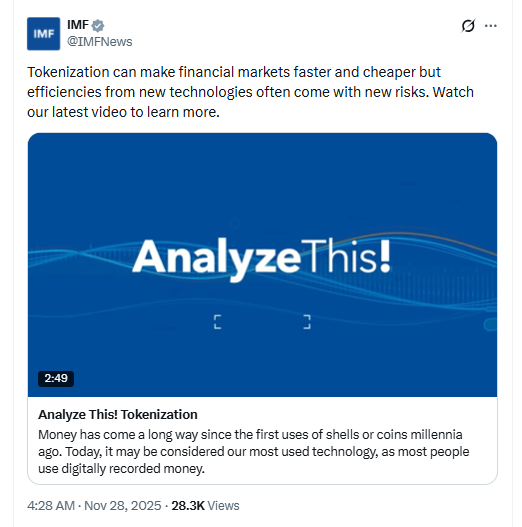
IMF Explainer Sets Out Tokenized Markets And Programmable Finance
In the video, the IMF describes tokenized markets as a new stage in the evolution of digital money and market infrastructure.
The fund says tokenization can make it “faster and cheaper to buy, own, and sell assets” by reducing long chains of intermediaries.
Instead of routing trades through registrars and clearinghouses, programmable finance moves core functions such as settlement and record-keeping into code.
Ownership and transfers can be updated directly on a shared ledger. That structure, the IMF notes, removes several legacy steps from the post-trade process.
Researchers studying early tokenized markets have already “found significant cost savings,”
the video says. Near-instant settlement and more efficient collateral use appear as key features of this programmable finance setup. At the same time, the IMF adds,
“Tokenization can make financial markets faster and cheaper, but efficiencies from new technologies often come with new risks.”
IMF Ties Tokenized Markets To Flash Crashes And Smart Contract Risk
After outlining these benefits, the IMF turns to the risk side of tokenized markets. It recalls that automated trading in traditional venues has “already led to sudden market plunges known as flash crashes.”
The video warns that tokenized markets, where trades and margin moves can execute instantly through smart contracts, “can be more volatile” than legacy systems.
When selling pressure intensifies, rules embedded in code can trigger rapid de-leveraging and forced sales. That process can turn a local imbalance into a flash crash.
In stressed conditions, long chains of smart contracts “written on top of each other” may interact “like falling dominoes,” the IMF explains.
A problem in one contract can propagate through others that depend on it. As a result, a small failure inside programmable finance can spread across tokenized markets and create a broader shock.
The IMF also points to fragmentation risk. If many separate tokenized markets develop that “don’t speak to each other,” liquidity can scatter across isolated pools.
In that case, the promise of cheap and fast execution may not extend across the full system, even though each platform uses tokenization and smart contracts.
IMF Tracks Government Intervention From Bretton Woods To Digital Money
The video then focuses on government intervention during past shifts in money. It states that “governments have rarely been content to stay on the sidelines during important evolutions of money.”
As one example, the IMF cites 1944, when the Bretton Woods agreement redesigned the global monetary system.
At that time, governments fixed exchange rates to the United States dollar, and the dollar itself was tied to gold. That choice set the architecture for cross-border finance for decades.
When the gold link became unsustainable in the early 1970s, governments moved to fiat currencies and floating exchange rates.
The IMF notes that many advanced economies then operated with structurally larger public-sector deficits. These episodes illustrate how government intervention can reset both monetary regimes and debt dynamics.
Drawing on this history, the IMF says governments are likely to take “a more active role in the future of tokenization.”
In other words, oversight of digital money, tokenized markets, and programmable finance will remain a policy issue rather than a purely technical design choice.
Tokenized Markets Grow With BlackRock BUIDL And Franklin Templeton
The IMF’s explainer appears while tokenized markets are already scaling into a multibillion-dollar segment. The video places its analysis alongside live products that apply tokenization to traditional assets.
One anchor example is BlackRock’s BUIDL fund, a tokenized Treasury vehicle. Public data show that BlackRock BUIDL has become the world’s largest tokenized Treasury fund.
It has overtaken Franklin Templeton’s Franklin OnChain US Government Money Fund and continued to grow through 2024 and 2025.
Both BlackRock BUIDL and the Franklin Templeton fund use tokenization to represent short-term U.S. government debt on-chain.
These funds sit at the point where conventional securities meet programmable finance.
They also show how large asset managers now treat tokenized markets as part of mainstream fixed-income strategies, not only as experiments tied to crypto-native tokens.
Within this landscape, the IMF uses its video to connect tokenized markets, flash crashes, smart contracts, and government intervention.
It presents tokenization and digital money as areas where cost savings, market design, and financial-stability concerns now intersect.
Disclosure:This article does not contain investment advice or recommendations. Every investment and trading move involves risk, and readers should conduct their own research when making a decision.
Kriptoworld.com accepts no liability for any errors in the articles or for any financial loss resulting from incorrect information.

Tatevik Avetisyan is an editor at Kriptoworld who covers emerging crypto trends, blockchain innovation, and altcoin developments. She is passionate about breaking down complex stories for a global audience and making digital finance more accessible.
📅 Published: November 28, 2025 • 🕓 Last updated: November 28, 2025
