

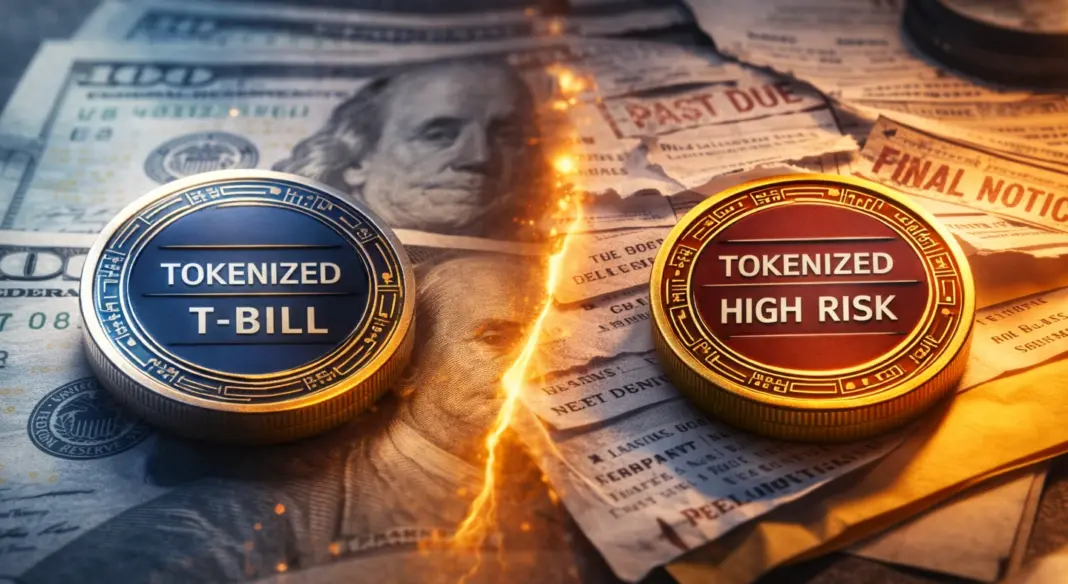

For a while, tokenization meant one thing: safe yield. Short-term government debt. Money market exposure. Clean, predictable returns wrapped into an onchain format that felt easy to understand.
That phase is still here. But it’s no longer the whole story.
Tokenized securities are starting to move beyond safety assets and into something less comfortable: real credit risk.
Stay ahead in the crypto world – follow us on X for the latest updates, insights, and trends!🚀
From safe yield to credit exposure
The first wave of tokenization focused on assets that were already considered low-risk in traditional finance.
T-bills made sense. They’re liquid, widely trusted, and regulators already know how to deal with them.
Putting them onchain gave users a simple upgrade: faster access, smaller minimums, and the ability to hold yield-bearing assets in a crypto-native environment.
But there’s a limit to how far that model can go. At some point, expanding tokenization means moving into assets where outcomes are less predictable. And that’s where things start to change.
OpenEden’s HYBOND and what it signals
OpenEden’s HYBOND launch is one of the clearest examples of this shift. Instead of wrapping government-backed instruments, HYBOND gives exposure to high-yield corporate bonds.
That means higher potential returns, but also real credit risk: companies can miss payments, spreads can widen, liquidity can dry up.
This changes what “onchain yield” actually means. You’re no longer just parking capital. You’re taking a risk, actively.
Why the first wave stayed in T-bills
There’s a reason tokenization started with the safest assets. They were easy to explain.
Easy to price. Easy to regulate. That made them ideal for proving the concept. Users could see immediate benefits without needing to understand complex risk dynamics.
But staying in that zone keeps tokenization limited. If everything remains low-risk and short-duration, the upside is capped.
Moving into corporate credit is a step toward a broader financial system onchain, not just a more efficient savings layer.
The “wave” shift is already happening
Grayscale’s research framing captures this transition well. The first wave was about convenience: making existing safe assets easier to access.
The next wave is about range: expanding into different risk profiles and making those exposures tradable in a more flexible way.
Comments at the Penn Blockchain Conference point in the same direction. Tokenization becomes more meaningful when it carries actual economic risk, not just idle capital.
That’s when it starts to resemble a real financial system rather than a wrapper layer.
What changes for users
If tokenized securities move deeper into credit markets, access changes first.
Corporate bonds have traditionally been harder to reach for smaller investors, because minimum sizes, slower settlement, and operational friction kept participation limited.
Onchain formats can reduce those barriers. Exposure becomes easier to enter, easier to adjust, and easier to combine with other positions. But the risk doesn’t shrink just because access improves.
Defaults still happen. Liquidity can still disappear at the wrong time. Pricing can still move against you quickly. The structure changes. The underlying reality doesn’t.
Takeaway
Tokenized securities are moving out of their comfort zone.
The shift from T-bills to high-yield credit marks a change from “safe yield onchain” to “risk-bearing assets onchain,” and OpenEden’s HYBOND is an early example of that transition.
The next phase of tokenization likely won’t be about how many low-risk assets can be wrapped.
We’ll have to ask about how well markets handle pricing, liquidity, and risk when those assets are no longer safe by default.

Crypto market researcher and external contributor at Kriptoworld
Wheel. Steam engine. Bitcoin.
📅 Published: April 3, 2026 • 🕓 Last updated: April 3, 2026
✉️ Contact: [email protected]
Disclosure:This article does not contain investment advice or recommendations. Every investment and trading move involves risk, and readers should conduct their own research when making a decision.
Kriptoworld.com accepts no liability for any errors in the articles or for any financial loss resulting from incorrect information.
