

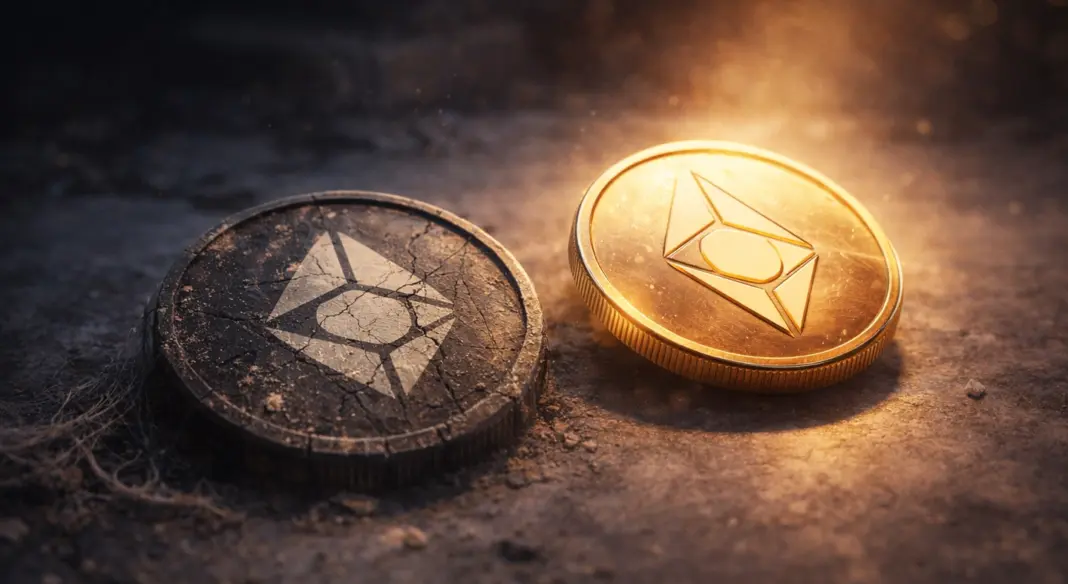

If you want to see where DeFi is heading, look at who is shutting down and who is still building.
This week gave the market a pretty clean split screen: Balancer Labs is winding down after the legal and economic fallout of a major exploit, while Ondo Finance and Glider are launching a platform for custom portfolios of tokenized US stocks.
Stay ahead in the crypto world – follow us on X for the latest updates, insights, and trends!🚀
Those two stories are not literally about the same thing. But together they show something bigger: the first generation of DeFi was built around token emissions, yield farming, pure-crypto liquidity games, and protocols that often moved faster than their security and legal wrappers could keep up.
The next generation looks more focused on regulated assets, cleaner interfaces, and products that feel closer to traditional finance than to the old on-chain casino model.
Why Balancer had to fold
Balancer Labs, the corporate entity behind the Balancer protocol, is shutting down after a November 3, 2025 exploit that drained roughly $128 million from Balancer v2 pools across Ethereum, Arbitrum, Base, Polygon, and several other chains, the protocol’s third known security breach, triggered by a rounding flaw in swap calculations that attackers exploited in under 30 minutes.
The Balancer protocol itself is not being turned off. Co-founder Fernando Martinelli said the protocol will continue under DAO and foundation governance, with core contributors pursuing a new service provider structure, the “Balancer OpCo”, pending a community vote.
DeFi is not disappearing. The corporate shell behind a protocol becomes legally and economically unsustainable after years of security incidents and one especially damaging exploit.
TVL had already been eroding for years, falling from roughly $3.3 billion at peak to about $800 million by October 2025, then dropping another $500 million in the two weeks after the hack to around $158 million today.
Martinelli was direct about the math: the exploit “created real and ongoing legal exposure” for the corporate entity, and maintaining that structure was no longer sustainable. The tech survived. The wrapper did not.
What Ondo and Glider represent
At almost the same moment, Ondo Finance and Glider launched what they describe as the first on-chain “direct indexing” solution for equities: a platform that lets users build and automatically rebalance custom portfolios of tokenized U.S. stocks without a traditional brokerage account, a crypto wallet, gas fees, or manual trading.
The platform combines Glider’s automation layer with Ondo’s tokenized real-world assets from its Ondo Global Markets platform, covering more than 200 U.S. stocks and ETFs now accessible to qualified non-U.S. investors in Europe, Asia-Pacific, Africa, and Latin America.
Glider CEO Brian Huang noted that unlike traditional ETFs, which bundle assets into fixed products and can face liquidity pressures at the fund level, users here hold the underlying tokenized assets directly.
Enabling 24/7 trading, fractional ownership, near-instant settlement, and the ability to plug positions into DeFi lending and yield strategies.
The platform is currently unavailable to U.S. investors, though Ondo maintains several SEC registrations that could eventually open a domestic path. Future expansions are planned into commodities and yield-generating features.
The growth numbers around tokenized RWAs help explain why this matters. RWA.xyz data shows tokenized RWAs have grown to about $26.5 billion in total value, up from around $7.5 billion a year ago, with tokenized stocks making up roughly $908.5 million of that market.
What the split really means
That is the generational divide. First-generation DeFi proved that blockchains could coordinate liquidity without banks, but it also accumulated smart-contract risk, governance complexity, and legal baggage that proved difficult to contain.
Newer DeFi projects are increasingly trying to look boring on purpose: more compliant, more asset-backed, and more useful to investors who care less about native tokens and more about clean access to stocks, dollars, and yield.
This is something new. DeFi is getting sorted. The part built around fragile token games and complex unsecured infrastructure is under pressure.
The part built around tokenized real-world assets and smoother user experiences is still attracting serious builders and capital.
Of course, that does not mean the new version is risk-free. But the market is getting more selective about what kind of on-chain finance deserves to survive, and this week drew that line pretty clearly.
Cryptocurrency and Web3 expert, founder of Kriptoworld
LinkedIn | X (Twitter) | More articles
With years of experience covering the blockchain space, András delivers insightful reporting on DeFi, tokenization, altcoins, and crypto regulations shaping the digital economy.
📅 Published: March 25, 2026 • 🕓 Last updated: March 25, 2026
✉️ Contact: [email protected]
Disclosure:This article does not contain investment advice or recommendations. Every investment and trading move involves risk, and readers should conduct their own research when making a decision.
Kriptoworld.com accepts no liability for any errors in the articles or for any financial loss resulting from incorrect information.
