


A new WhatsApp privacy lawsuit landed in a U.S. district court in San Francisco on Friday, accusing Meta of having backdoor access to WhatsApp chats.
The plaintiffs say the claim threatens the privacy of more than 3 billion users.
Stay ahead in the crypto world – follow us on X for the latest updates, insights, and trends!🚀
On Monday, Meta communications director Andy Stone rejected the accusation on X. He wrote:
“Any claim that people’s WhatsApp messages are not encrypted is categorically false and absurd,” and he called the case a “frivolous work of fiction.”
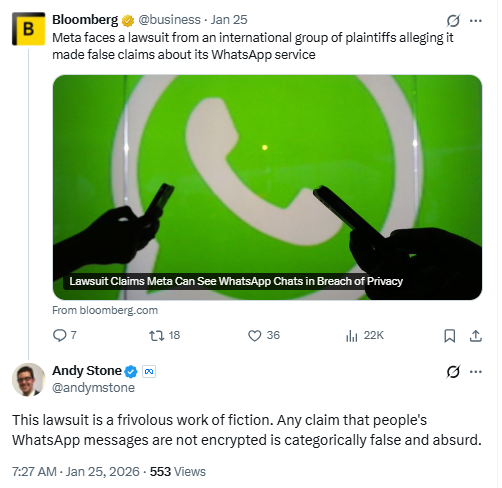
WhatsApp Privacy Lawsuit Targets Meta Backdoor Access Claims
The WhatsApp privacy lawsuit was filed by a group of WhatsApp users based in Australia, Mexico, South Africa, and India. The filing argues that users relied on privacy promises while sending sensitive messages.
The plaintiffs describe WhatsApp’s end-to-end encryption as a “sham.” They are seeking damages from Meta, saying the company misled users about how private chats are.
The lawsuit says it aims to “expose the fundamental privacy violations and fraud” that Meta allegedly committed. It claims people used WhatsApp believing their communications stayed fully private.
End-to-End Encryption Debate Puts WhatsApp Claims Under Pressure
In his post, Andy Stone tied his denial to WhatsApp’s encryption design. He framed the lawsuit’s core idea as incompatible with how the app protects messages.
While Meta has not issued a separate public statement, WhatsApp’s own explainer page outlines its position. It says:
“End-to-end encryption helps protect your privacy by ensuring no one sees your messages except you.”
The case focuses on whether that promise matches real-world access and control. That question matters because encryption claims often shape user trust and product choice.
Bitchat and Decentralized Messaging Apps Gain Attention After WhatsApp Privacy Lawsuit
The lawsuit arrives as privacy concerns grow around centralized messaging services. Some users now look for tools that reduce dependence on big platforms.
The report linked that shift to Bitchat, a decentralized encrypted messenger associated with Jack Dorsey. It uses Bluetooth mesh networks, which can allow messaging without the internet in certain situations.
The report said Bitchat downloads recently jumped in Uganda, Iran, Nepal, Indonesia, and Jamaica, among other places. It tied that rise to social media restrictions and to communication needs during natural disasters.
Pavel Durov, CEO of WhatsApp rival Telegram, publicly backed the lawsuit.
“You’d have to be braindead to believe WhatsApp is secure in 2026. When we analyzed how WhatsApp implemented its ‘encryption’, we found multiple attack vectors.”
The report also pointed to other decentralized messengers with encryption features, including Session and X-Messenger.
Disclosure:This article does not contain investment advice or recommendations. Every investment and trading move involves risk, and readers should conduct their own research when making a decision.
Kriptoworld.com accepts no liability for any errors in the articles or for any financial loss resulting from incorrect information.

Tatevik Avetisyan is an editor at Kriptoworld who covers emerging crypto trends, blockchain innovation, and altcoin developments. She is passionate about breaking down complex stories for a global audience and making digital finance more accessible.
📅 Published: January 27, 2026 • 🕓 Last updated: January 27, 2026
