

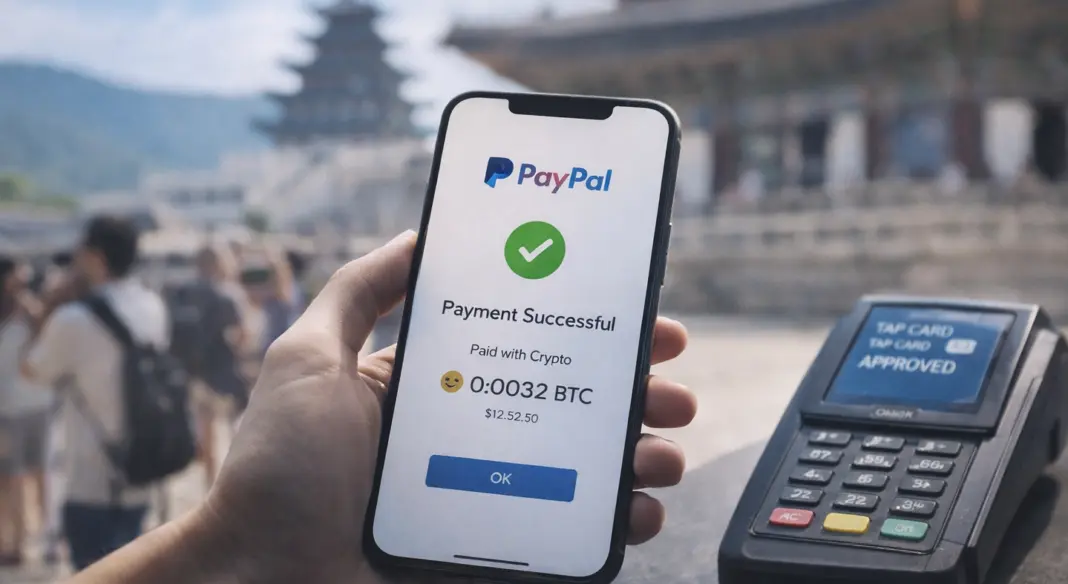

If you pay with crypto in South Korea this year, there’s a good chance nobody behind the counter will even notice.
Crypto.com has teamed up with local payment giants and card issuers to let foreign tourists spend digital assets at merchants across the country, while shops still see familiar card and local payment flows in won on their terminals.
Stay ahead in the crypto world – follow us on X for the latest updates, insights, and trends!🚀
At the same time, PayPal’s PYUSD stablecoin is quietly expanding across chains and geographies, turning into a settlement layer that most people experience simply as “PayPal or Venmo, but a bit more flexible on the back end.”
What Crypto.com is testing with tourists in Korea
Crypto.com’s newest push with Korean partners targets a very specific niche: foreign travelers spending money in Korea using familiar card rails but funding them with stablecoins.
Through Crypto.com cards and wallet integrations, tourists can top up a prepaid VISA with USDC, then tap or swipe at participating merchants; under the hood, the spend is funded by crypto, while merchants choose to settle in fiat and never have to touch a wallet or private key.
Hana Card, part of Hana Financial Group, is piloting USDC‑funded prepaid cards that offer 5% cashback in CRO to foreign visitors, using existing card networks but stablecoins as the funding source.
Local payment rails like KSNET and KG Inicis collectively process hundreds of thousands of merchants, around 130 million transactions per month, and roughly 4 billion dollars in monthly volume, so the pilot’s flows are tiny compared to the base; the point isn’t to replace Korea’s payment system overnight, but to test whether crypto‑funded cards and wallets can slot into it without breaking anything.
How PayPal is scaling PYUSD in the background
PayPal is running a similar playbook at a different scale. Its PYUSD stablecoin, launched first on Ethereum, has expanded to additional blockchains like Solana, leveraging faster and cheaper rails while cross‑chain protocols keep balances fungible across ecosystems.
Supply has grown into the hundreds of millions of dollars, with usage spanning exchanges, DeFi integrations, and cross‑border services such as Xoom in dozens of markets.
For everyday PayPal and Venmo users, though, the experience still looks like PayPal: balances in dollars, peer‑to‑peer transfers, and merchant payments through a familiar interface, while PYUSD handles settlement and liquidity routing in the background.
The wallet even shows PYUSD as a unified balance regardless of whether it sits on Ethereum or Solana, and only when you withdraw to an external wallet do you have to pick a chain at all.
The common thread: crypto as a hidden payment layer
Taken together, these two stories point in the same direction. In Korea, tourists tap a card or scan a code, merchants get paid in won if they want, and KSNET or KG Inicis still dominate the visible rails, but some of that spending is now funded by USDC and CRO‑incentivized cards under the hood.
With PayPal, PYUSD is turning into an infrastructure token: a way to move dollars across chains and platforms, while the user just sees a PayPal balance and a familiar “Pay” button.
Right now, the important shift is this: “crypto payments” may not look like QR codes and on‑chain prompts at every checkout.
They’re more likely to start in specific corridors, think tourism, cross‑border commerce, e‑commerce platforms, where stablecoins quietly power settlement under brands people already trust, and by the time it feels mainstream, you may not see the crypto at all.
You’ll just notice that your card or wallet works in more places, a bit faster, with fewer surprises on the statement.

Cryptocurrency and Web3 expert, founder of Kriptoworld
LinkedIn | X (Twitter) | More articles
With years of experience covering the blockchain space, András delivers insightful reporting on DeFi, tokenization, altcoins, and crypto regulations shaping the digital economy.
📅 Published: March 18, 2026 • 🕓 Last updated: March 18, 2026
✉️ Contact: [email protected]
Disclosure:This article does not contain investment advice or recommendations. Every investment and trading move involves risk, and readers should conduct their own research when making a decision.
Kriptoworld.com accepts no liability for any errors in the articles or for any financial loss resulting from incorrect information.
