


The Ethereum Fusaka upgrade is now live on the Ethereum mainnet.
The network activated the Ethereum Fusaka upgrade at 9:49 pm UTC on Wednesday, at Epoch 411392.
Stay ahead in the crypto world – follow us on X for the latest updates, insights, and trends!🚀
The change brings higher Ethereum data throughput, lower transaction costs and new tools that aim to support smoother user experiences.
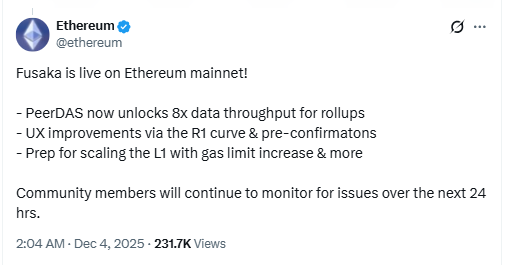
The core feature of the Ethereum Fusaka upgrade is PeerDAS, short for peer data availability sampling.
PeerDAS changes how Ethereum and rollups handle data used by Layer 2 systems. As a result, the mechanism targets scale and cost at the same time.
Earlier this week, the Ethereum Foundation published a detailed thread on its X account.
The post explained what the Ethereum Fusaka upgrade and PeerDAS mean for users, developers, node operators, Layer 2s, rollups and enterprises.
It linked changes in data handling to fees and to Ethereum instant-feel UX goals.
The Foundation said Fusaka moves Ethereum closer to “near-instant transactions.”
It tied this to improved latency and a more fluid interface for applications that depend on rollups and other scaling tools.
PeerDAS in the Ethereum Fusaka upgrade and ‘instant-feel’ UX
According to the Ethereum Foundation, the Ethereum Fusaka upgrade “lays the groundwork for ‘instant-feel’ user experiences.” It connects this goal to preconfirmations, which can reduce latency “from minutes to milliseconds.”
Preconfirmations give an early signal that a transaction is very likely to be included in a block.
Therefore, wallets and dapps can show faster feedback while the transaction still moves toward final settlement.
This design aims to support Ethereum instant-feel UX without changing the core security model.
The Foundation also links PeerDAS to cost. It says the combination of lower fees and reduced latency “opens the door for a new tier of usability.”
In this context, the Ethereum Fusaka upgrade is described as a step that joins UX and cost rather than treating them separately.
At the same time, the thread stresses that Ethereum still keeps full settlement on the base layer.
PeerDAS changes how the network checks and moves rollup data. It does not replace Ethereum’s existing consensus or execution layers.
How PeerDAS changes Ethereum data throughput and Layer 2 fees
For Layer 2s and rollups, the Ethereum Foundation says the Ethereum Fusaka upgrade and PeerDAS can “unlock up to 8x data throughput.”
The focus is on how rollup blobs travel across the network and how nodes confirm that those blobs are available.
In simple terms, PeerDAS breaks each large blob of rollup data into many smaller cells. Every node stores and checks only a small share of those cells.
As a result, nodes download and upload less data, yet the network can still verify that the full blob exists.
This design supports higher Ethereum data throughput, since more blobs can move through the system without overloading individual machines.
It also means that nodes do not need very heavy hardware to participate in sampling, which helps keep Ethereum’s validator set broad.
For rollups, the Foundation says this approach leads to cheaper blob fees and “more space to grow.”
If blob fees fall, Ethereum Layer 2 fees can also come down, because rollups pay less to post transaction data back to Ethereum. More capacity also allows Layer 2s to handle additional user activity during busy periods.
The Foundation notes that PeerDAS aims to keep the network decentralized while delivering these changes.
Sampling only a fraction of data lets more participants stay in the network without major upgrades to their equipment.
Disclosure:This article does not contain investment advice or recommendations. Every investment and trading move involves risk, and readers should conduct their own research when making a decision.
Kriptoworld.com accepts no liability for any errors in the articles or for any financial loss resulting from incorrect information.

Tatevik Avetisyan is an editor at Kriptoworld who covers emerging crypto trends, blockchain innovation, and altcoin developments. She is passionate about breaking down complex stories for a global audience and making digital finance more accessible.
📅 Published: December 4, 2025 • 🕓 Last updated: December 4, 2025
