

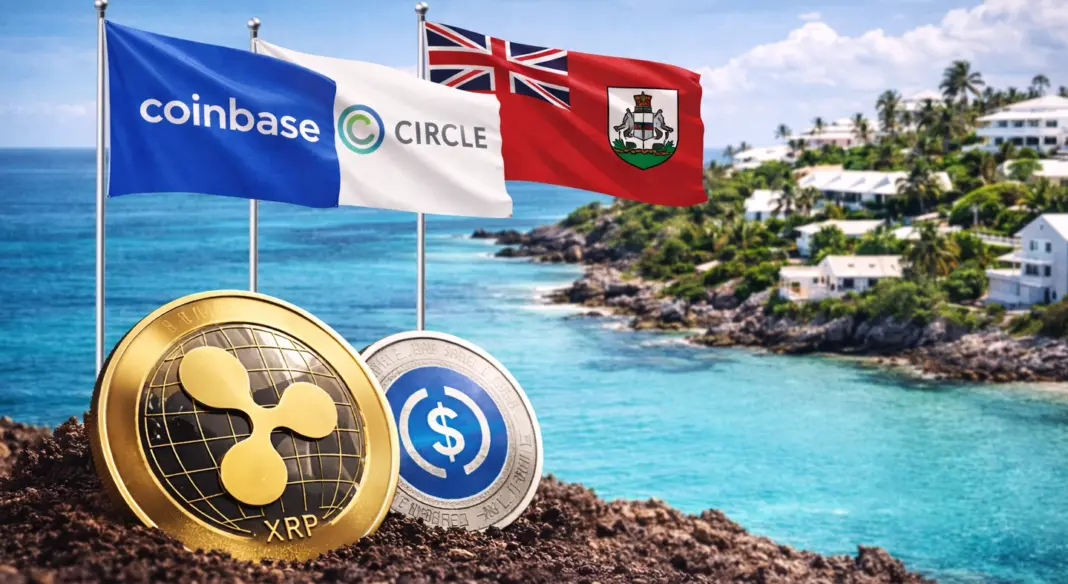

Bermuda is going all-in on becoming the first “fully onchain” national economy.
They’re partnering with Coinbase and Circle to weave digital assets and stablecoins like USDC into everyday government, business, and consumer life.
Stay ahead in the crypto world – follow us on X for the latest updates, insights, and trends!🚀
Announced at Davos during the World Economic Forum, this is a country-level bet on blockchain as core financial infrastructure.
What the Bermuda-Coinbase-Circle Partnership Actually Involves
The Government of Bermuda will get digital asset tools from Coinbase and Circle to roll out across agencies, local banks, insurers, SMBs, and regular people.
Think stablecoin payments for daily use, tokenization for finance, and nationwide education/onboarding programs.
Premier E. David Burt framed it as “creating opportunity, lowering costs, and ensuring Bermudians benefit from the future of finance.”
Classic buzzword-salad, but this time it might be true.
USDC is central, fast, low-cost dollar payments that already work with some local merchants.
The plan builds on Bermuda’s 2018 Digital Asset Business Act (one of the first comprehensive regs), where both Coinbase and Circle got early licenses.
Discussions kicked off at the Bermuda Digital Finance Forum last May, including a USDC airdrop to attendees.
Next year’s forum will scale it further with more businesses, consumer stimulus, and deeper sector involvement.
It’s non-exclusive, no lock-in to just these two firms, and voluntary for adoption.
Stablecoin and Onchain Adoption Trends
Stablecoins have been gaining way bigger real-world traction since 2022–2023, especially in places with expensive or restricted traditional rails.
We’ve seen pilots in emerging markets (e.g., remittances in Latin America or Africa using USDC/USDT), but now Bermuda is pushing it to national scale.
We’ve seen similar moves already, from example El Salvador with Bitcoin as legal tender, or smaller jurisdictions like the Marshall Islands exploring digital currencies.
But Bermuda’s advantage? Strong early regs drew big players, and its island economy already faces high fees from being lumped with Caribbean peers.
This echoes how DeFi shifted from hype to practical use cases, stablecoins as everyday money instead of just trading tools.
The airdrop and merchant onboarding last year showed early proof, now it’s going bigger.
Onchain as a Fix for Island Economies’ Pain Points
Small, isolated places have always hunted for better financial access.
Traditional banking in islands like Bermuda means high costs, slow transfers, and thin margins, getting grouped with riskier Caribbean spots limits access to onshore processors.
Crypto promises the opposite, instant, low-fee, borderless payments without middlemen. Think Western Union-style remittances but cheaper and faster via USDC wallets.
Industry experts say Bermuda’s move could disrupt like how mobile money (M-Pesa in Kenya) leapfrogged bad banking infrastructure in Africa, suddenly everyone has access without legacy constraints.
At national level, it could keep more economic value circulating locally instead of leaking to foreign banks.
TradFi has always struggled with small markets, onchain infrastructure could level the playing field for places like Bermuda, making global finance truly inclusive. I mean now for real.
A National Onchain Economy, First of Its Kind
We all know that lower transaction costs, better global access via digital wallets, and more resilient finance sound great for residents and businesses.
If it works, Bermuda becomes a showcase, proof onchain can fix real-world problems in small economies, potentially inspiring others.
Yes, adoption might stay voluntary and slow, that’s true. People stick to what they know, and volatility scares off casuals.
Regs are solid here, but scaling education and infrastructure takes time, if it fizzles, it’s just another pilot.
Still, starting from early licenses and real merchant use to full national integration isn’t small potatoes.
Genuine Play, Or Games of Influence?
Some might call it big crypto firms buying influence in a tiny jurisdiction. Critics could say it’s aspirational hype without mandates.
Maybe a bit of both. But the on-chain focus and voluntary angle keep it grounded, Bermuda’s not forcing anyone, it’s just offering tools that solve actual pain points.
The data will tell if people actually use it.
Bermuda’s push with Coinbase and Circle could turn a small island into an onchain pioneer.
If residents and businesses bite, it shows crypto can go beyond trading to real national infrastructure. We’ll see if this becomes a model or stays a nice idea.
Disclosure:This article does not contain investment advice or recommendations. Every investment and trading move involves risk, and readers should conduct their own research when making a decision.
Kriptoworld.com accepts no liability for any errors in the articles or for any financial loss resulting from incorrect information.

Cryptocurrency and Web3 expert, founder of Kriptoworld
LinkedIn | X (Twitter) | More articles
With years of experience covering the blockchain space, András delivers insightful reporting on DeFi, tokenization, altcoins, and crypto regulations shaping the digital economy.
📅 Published: January 23, 2026 • 🕓 Last updated: January 23, 2026
✉️ Contact: [email protected]
