

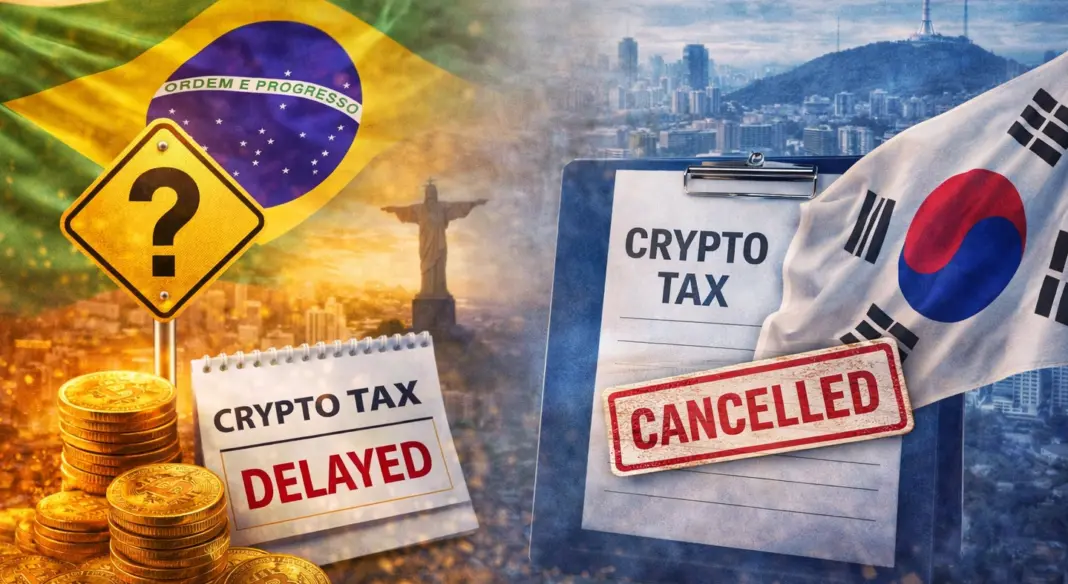

Same asset class, two very different political instincts from the two different parts of the world. In Brazil, the government is backing away from a new crypto tax fight ahead of an election.
In South Korea, the main opposition wants to abolish a planned crypto gains tax before it even starts.
For investors, this kind of political chess matters more than many people realize: your real crypto return is not just about whether prices go up, but about what your local tax system decides to take after the fact.
Stay ahead in the crypto world – follow us on X for the latest updates, insights, and trends!🚀
And that is increasingly being shaped by electoral strategy, capital‑flight fears, and competition between jurisdictions.
Brazil: delay, not surrender
Brazil’s new finance minister, Dario Durigan, who replaced Fernando Haddad after Haddad stepped down to run for governor of São Paulo, has shelved a planned public consultation on tighter crypto taxation.
The consultation, which followed a central bank regulation that began treating certain crypto movements like foreign exchange transactions, would have covered how crypto profits, offshore platform activity, and foreign‑listed ETFs should be reported and taxed under Brazil’s evolving framework.
That does not mean Brazil is becoming sweepingly crypto‑friendly. But it does mean the Lula government appears unwilling to provoke retail investors, fintech firms, and market infrastructure groups with a divisive new tax push right before a national vote.
The current regime stays in place for now, including the 17.5% flat tax on crypto capital gains introduced in June 2025.
The practical effect is short‑term relief but lingering ambiguity: by freezing the consultation, Brazil avoids an immediate backlash while leaving unresolved questions about offshore flows, digital asset reporting, and the tax treatment of newer crypto‑linked products.
South Korea: scrap it altogether
South Korea is moving in almost the opposite direction.
The People Power Party has introduced a bill led by floor leader Song Eon‑seok to permanently abolish the virtual asset gains tax scheduled to take effect on January 1 next year, the fourth time the tax has faced a serious challenge after being postponed three times already since 2022.
🇰🇷JUST IN: SOUTH KOREA OPPOSITION MOVES TO SCRAP 2027 CRYPTO TAX ENTIRELY
South Korea's opposition party has introduced a bill to fully abolish the planned 22% crypto capital gains tax scheduled for 2027.
The party argues that it creates an unfair disparity, given that stock… pic.twitter.com/BunESTNyVS
— BSCN (@BSCNews) March 19, 2026
Under the existing framework, crypto gains above 2.5 million won (around 1,665 dollars) would face a 20% national income tax plus a 2% local surcharge, for a combined maximum rate of 22%.
The PPP’s core argument is tax fairness: South Korea abolished its income tax on stock trading gains in late 2024 to protect retail investors, so taxing crypto profits at 22% while stock gains are tax‑free creates an obvious double standard.
Beyond fairness, there is a hard economic number behind the push: estimates suggest around 110 billion dollars in capital flowed out of South Korean domestic crypto exchanges to foreign platforms in 2025 alone, a level of outflow that gives the capital‑flight argument real political weight.
The bill still needs National Assembly approval to become law, and the ruling party has said it will review the proposal rather than immediately support it.
In a country where roughly one in five people trades crypto, however, even the attempt is a significant political signal.
What’s next?
These two cases together show that crypto tax policy is becoming a capital‑flows issue as much as a regulatory one. Brazil is pausing change to avoid political costs ahead of a vote.
South Korea’s opposition is promising abolition to keep traders, exchanges, and younger voters from moving their activity offshore.
The lesson here is direct: when planning long‑term crypto exposure, watch tax politics as closely as token charts. The blockchain determines what you can do with your assets.
But the state decides what you actually keep, and right now those two conversations are happening in very different rooms, on very different timelines, driven by electoral calendars as much as financial logic.

Crypto market researcher and external contributor at Kriptoworld
Wheel. Steam engine. Bitcoin.
📅 Published: March 24, 2026 • 🕓 Last updated: March 24, 2026
✉️ Contact: [email protected]
Disclosure:This article does not contain investment advice or recommendations. Every investment and trading move involves risk, and readers should conduct their own research when making a decision.
Kriptoworld.com accepts no liability for any errors in the articles or for any financial loss resulting from incorrect information.
