

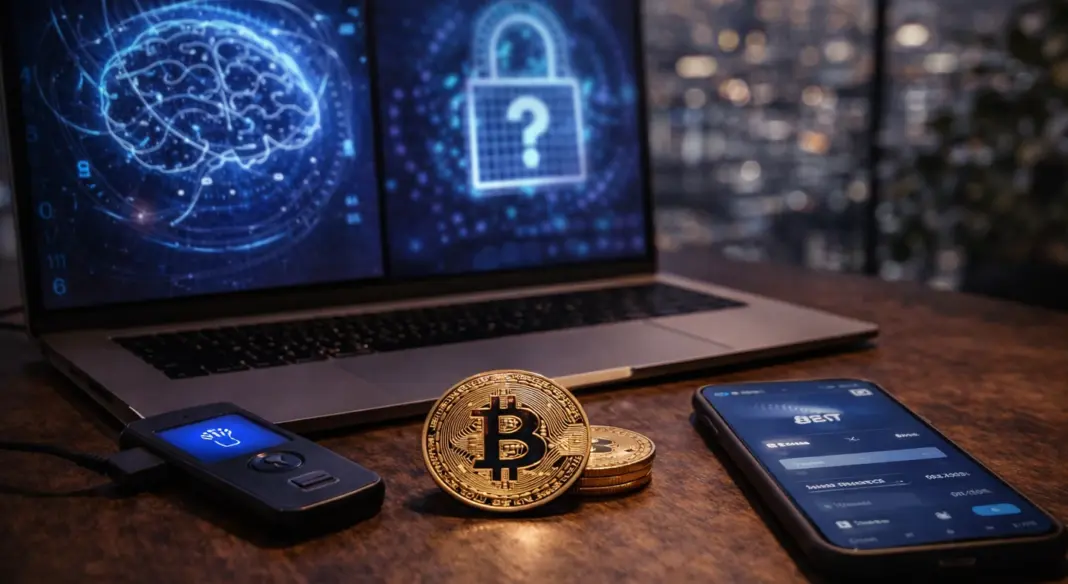

“Quantum will break Bitcoin” is the kind of headline that makes casual holders either panic or tune out completely.
The better question is far more specific: if you hold bitcoin today, are your coins actually at risk, or is this mainly a problem for older wallet setups, reused addresses, and coins whose public keys are already visible on‑chain?
Stay ahead in the crypto world – follow us on X for the latest updates, insights, and trends!🚀
The quantum threat is both real and very easy to overstate, and where you land on it has real consequences for how you manage and move your coins.
What’s actually at risk
The core fear is not that quantum computers would “hack the blockchain” in some vague movie‑style way.
The more precise concern is that a sufficiently powerful quantum machine could derive a private key from an exposed public key, allowing an attacker to forge signatures and drain specific wallets.
According to Galaxy Digital’s research, most wallets are not vulnerable today because funds are only at risk when a public key is visible on‑chain, and that exposure primarily occurs in two scenarios: wallets whose public keys are already sitting on the blockchain, and coins that reveal public keys during a spend transaction.
Current estimates suggest around 6.5 million BTC, that’s roughly a third of the total supply, sit in addresses already considered susceptible, including coins mined by Satoshi Nakamoto during Bitcoin’s earliest days.
Taproot addresses introduced in 2021 also expose the public key during the spending process, adding another category of long‑term exposure if quantum hardware matures.
This is why wallet hygiene matters more than most headline readers realize: address reuse, older address formats, and frequent spending from the same address can all increase how much public‑key data you leave visible on‑chain over time.
Why developers are paying attention now
One reason the debate has grown louder is that Bitcoin developers are no longer treating it as a fringe topic.
In February 2026, BIP 360, a proposal introducing a new Pay‑to‑Merkle‑Root address type that eliminates the vulnerable key‑to‑spend path, was formally merged into the Bitcoin Core BIP repository, marking the first concrete step toward a post‑quantum migration path.
Galaxy Digital’s broader review found active work across the Bitcoin ecosystem on both identifying vulnerabilities and building mitigation tools, directly pushing back on the popular claim that Bitcoin Core contributors are ignoring the problem.
The governance picture is the real complexity. Bitcoin has no CEO and no central authority, which means any eventual migration will require broad coordination across miners, exchanges, wallet providers, and ordinary users, all moving at different speeds.
That is actually one reason the conversation is happening now rather than later, if a credible quantum threat is years or even decades away, a slow‑moving decentralized network needs to begin planning well in advance, because upgrading distributed monetary infrastructure is orders of magnitude harder than patching a normal app.
The U.S. National Security Agency’s own CNSA 2.0 guidelines already call for a shift to quantum‑safe cryptography by 2030 for national security systems, a signal that major institutions take the timeline seriously even if no consensus exists on exactly when Q‑Day arrives.
Why “quantum” no longer sounds entirely abstract
It is also easier to dismiss quantum risk when the word “quantum” reads like a sci‑fi prop.
That is where a very different piece of news this week is useful context, even though it has nothing to do with Bitcoin directly.
Researchers at CSIRO, Australia’s national science agency, working with RMIT University and the University of Melbourne have built the world’s first operational proof‑of‑concept quantum battery: a real physical object that charges, stores, and discharges energy using quantum effects rather than standard battery chemistry, with the work published in Nature journal Light: Science & Applications.
The prototype is charged wirelessly via femtosecond laser pulses, stores energy for nanoseconds, and demonstrates a counterintuitive quantum behavior the team calls “superabsorption“, larger systems charge faster rather than slower, the exact opposite of how conventional batteries behave.
It is nowhere near commercial grade and it will not power your phone anytime soon.
But its existence makes one broader point harder to wave away: quantum ideas are increasingly moving from chalkboard theory into working hardware, and across a wider range of engineering domains than most people track.
What a retail bitcoin holder should actually do
For most retail users, the practical conclusion is not “sell your BTC before quantum computers arrive.”
It is to recognize that the risk is tied to specific wallet designs and spending behaviors, and that better habits today can reduce future exposure without doing anything drastic right now.
A few habits are likely worth building: avoid unnecessary address reuse, because the same address used repeatedly can increase the on‑chain public‑key footprint over time, keep using reputable, actively maintained wallets that are likely to implement any future post‑quantum migration features, and stay loosely aware of BIP‑level proposals like BIP 360, because if Bitcoin eventually adopts a broader transition, users may need to actively move funds to new address types rather than being protected automatically.
Quantum risk to Bitcoin is real enough that developers are working on it now, specific enough that not every wallet is equally exposed, and distant enough that the right response is preparation rather than panic.
That may be less dramatic than the average headline, but it is much closer to the truth.

Crypto market researcher and external contributor at Kriptoworld
Wheel. Steam engine. Bitcoin.
📅 Published: March 21, 2026 • 🕓 Last updated: March 21, 2026
✉️ Contact: [email protected]
Disclosure:This article does not contain investment advice or recommendations. Every investment and trading move involves risk, and readers should conduct their own research when making a decision.
Kriptoworld.com accepts no liability for any errors in the articles or for any financial loss resulting from incorrect information.
