



Crypto’s wild ride is not over, but the script is changing. Galaxy Digital’s Steve Kurz calls it the “great convergence” — a slow but steady merge between crypto and traditional finance where institutions stop treating digital assets as a sideshow and start slotting them into core portfolios.
MSCI’s decision to keep digital asset companies in its indices adds fuel, benchmarks are quietly legitimizing the space.
Stay ahead in the crypto world – follow us on X for the latest updates, insights, and trends!🚀
The result? Less chaos, more structure, and a market that’s finally behaving like a grown-up.
What “great convergence” actually looks like
Kurz, Galaxy’s asset management chief, described the recent sell-off as healthy deleveraging, nothing catastrophic, just the market shedding excess leverage after last year’s run-up.
He sees range-bound trading ahead, followed by gradual gains driven by institutional capital flows.
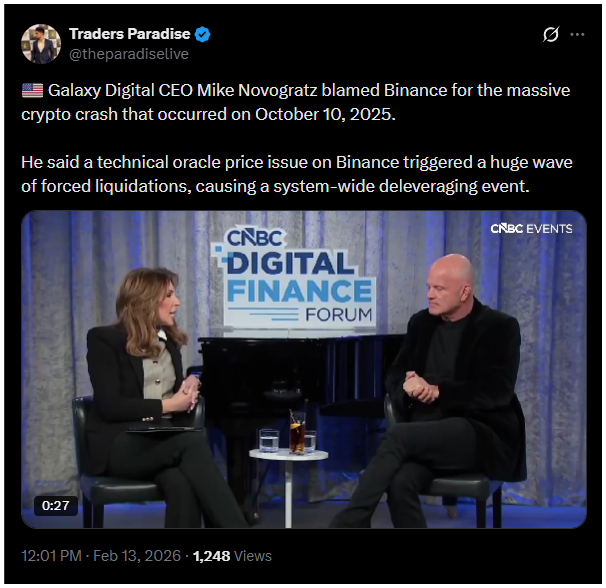
The key shift: demand channels have matured. In 2025, $44 billion in net spot inflows from ETFs and treasury firms got absorbed without explosive price action because long-term holders supplied most of the float.
That kept volatility in check and prices grounded even as macro headwinds, moderate growth, sticky inflation, slower policy easing, weighed on risk assets.
MSCI’s move reinforces this. By not removing digital asset firms from its indices, the index giant signals that crypto-related companies are now part of the “normal” investable universe. This is not flashy news, but it’s important.
Pension funds, endowments, and asset managers that track MSCI benchmarks get indirect exposure without needing special mandates. Crypto stops being “alternative” and starts being “standard.”
How this fits the maturing institutional playbook
This convergence has been building since 2022. Post-FTX, institutions demanded proof of reserves, audited custody, and regulatory clarity, exactly what ETFs and index inclusion provide.
Stablecoins became backend for onchain flows, while tokenized RWAs opened doors to real assets without legacy friction.
Galaxy’s view aligns with what we’ve seen: liquidity clusters around large-caps, DeFi protocols stabilize, and regulation adds guardrails instead of roadblocks.
The pattern is clear: crypto is being folded into the broader market fabric, not disappearing into a black swan event.
When MSCI keeps digital firms in play, it tells allocators “this belongs here.” When Galaxy sees deleveraging as healthy, it signals maturity.
From fringe to fixture
Simply put, this is crypto’s quiet normalization. Traditional portfolios have always allocated to “risk assets” like equities or commodities.
Bitcoin’s role as the macro hedge is solidifying, but now it’s sharing shelf space with tokenized bonds, funds, and equities.
MSCI’s decision is the institutional stamp: if index giants nod, trillions in passive capital follow. For retail, this matters because institutional flows dampen volatility. No more 3x pumps on rumor alone, prices move on real demand.
The downside? Slower moonshots. The upside? More predictable growth, less rug-pull risk.
It’s the difference between a casino and a market.
What this means in practice
Institutional scaffolding means fewer death spirals and more consistent upside. Bitcoin could grind higher on steady inflows rather than relying on retail FOMO.
Of course, compressed volatility might bore degen traders, and if macro stays heavy, even structured markets can stagnate.
But $44B absorbed quietly in 2025? That’s proof the system works.
Some will shrug, Galaxy’s an exchange, MSCI’s just indexing. Maybe there’s truth there, convergence can feel exclusive if you’re not in the institutional club. But the data doesn’t lie: inflows happened, prices didn’t explode, benchmarks stayed put.
Crypto’s “great convergence” is turning it from fringe asset to portfolio fixture. Less fireworks, more foundations.
We’ll see if institutions keep showing up when the next storm hits.

Cryptocurrency and Web3 expert, founder of Kriptoworld
LinkedIn | X (Twitter) | More articles
With years of experience covering the blockchain space, András delivers insightful reporting on DeFi, tokenization, altcoins, and crypto regulations shaping the digital economy.
📅 Published: February 16, 2026 • 🕓 Last updated: February 16, 2026
✉️ Contact: [email protected]
Disclosure:This article does not contain investment advice or recommendations. Every investment and trading move involves risk, and readers should conduct their own research when making a decision.
Kriptoworld.com accepts no liability for any errors in the articles or for any financial loss resulting from incorrect information.
