

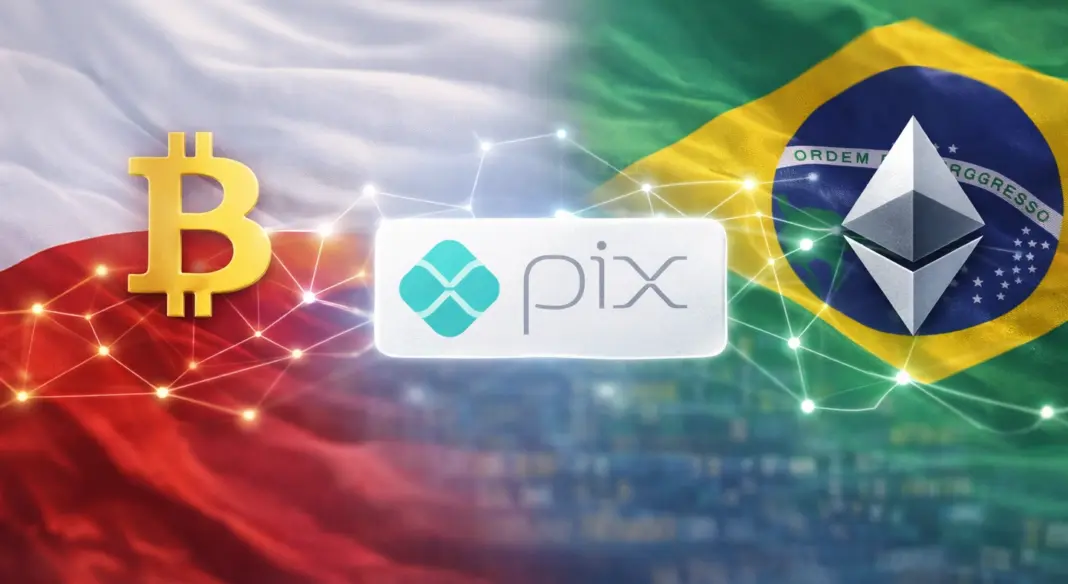

“Crypto adoption” is often described as a single global wave. Reality looks more uneven.
Two different engines of adoption are operating at the same time. One focuses on regulatory frameworks that shape how companies can build and operate.
Stay ahead in the crypto world – follow us on X for the latest updates, insights, and trends!🚀
The other focuses on payment rails that change how people actually move money.
Europe currently sits in the rule-writing phase. Poland has filed a pro-crypto bill designed to align with the European Union’s MiCA framework. Latin America shows a different kind of momentum.
Brazil’s Pix payment system is expanding into Argentina, bringing its instant digital payment model across borders.
Both developments point toward financial modernization, but they operate at different layers of the system: rules and rails.
Poland’s MiCA-aligned approach
The EU already has a regulatory foundation for digital assets through the MiCA framework.
National initiatives still matter because each country can shape how that framework is interpreted and applied.
A pro-crypto legislative push signals that policymakers want to attract digital asset companies and financial technology builders.
The details can influence licensing timelines, enforcement practices, and the overall environment for exchanges, custodians, and fintech startups.
Signals like these shape where companies decide to operate. They influence whether capital, talent, and infrastructure cluster in a particular jurisdiction.
Changes at the policy layer usually take time before they affect everyday users, and their impact tends to appear first in business activity and investment decisions.
Brazil’s Pix expansion shows the power of rails
Pix operates at a completely different layer of the financial system. It is not a simple crypto network.
It is a payment rail that allows instant transfers between accounts, and since its launch, Pix has rapidly become part of daily financial life in Brazil.
Expanding Pix into Argentina extends that behavior across borders.
Instant settlement, minimal friction, and simple digital payments make transferring money easier for individuals and businesses alike.
Payment rails change habits faster than regulatory frameworks, and when transfers become cheap, fast, and simple, digital money begins to feel normal for the average person.
Infrastructure that works smoothly often drives adoption long before policy debates settle.
Adoption involves more than tokens
Crypto adoption is often framed around buying and holding digital assets, but in reality, the broader environment matters just as much.
Payment infrastructure determines how easily digital money moves.
Regulatory frameworks determine whether companies can build services around those rails. On-ramps connect traditional finance to digital markets.
When these pieces function together, digital finance becomes practical rather than experimental, policy signals can attract long-term investment and institutional participation, and payment systems can shape everyday behavior much faster.
Rules and rails move together
A functioning financial ecosystem needs both layers. Clear rules allow companies to operate without constant legal uncertainty.
Payment rails allow users to interact with digital money in ways that feel natural and efficient.
Poland’s legislative effort operates at the rule layer, signaling openness to crypto businesses within the MiCA framework.
Brazil’s Pix expansion operates at the infrastructure layer, extending digital payment habits across borders.
Crypto adoption tends to accelerate when those two layers reinforce each other.

Crypto market researcher and external contributor at Kriptoworld
Wheel. Steam engine. Bitcoin.
📅 Published: March 11, 2026 • 🕓 Last updated: March 10, 2026
✉️ Contact: [email protected]
Disclosure:This article does not contain investment advice or recommendations. Every investment and trading move involves risk, and readers should conduct their own research when making a decision.
Kriptoworld.com accepts no liability for any errors in the articles or for any financial loss resulting from incorrect information.
