



Most people don’t think about credit unions every day, but for millions of Americans they are the regular bank.
These are not-for-profit institutions that serve teachers, nurses, military families, and everyday working people.
Stay ahead in the crypto world – follow us on X for the latest updates, insights, and trends!🚀
They are often smaller and more community-focused than big commercial banks.
Now something interesting is happening in that world.
US bank stablecoin rules take first concrete step
The National Credit Union Administration, the NCUA, the regulator that oversees these institutions, has proposed the first rules that would allow credit unions to issue their own stablecoins.
This is the first concrete step under the new GENIUS Act, which is trying to create a clear federal framework for payment stablecoins in the United States.
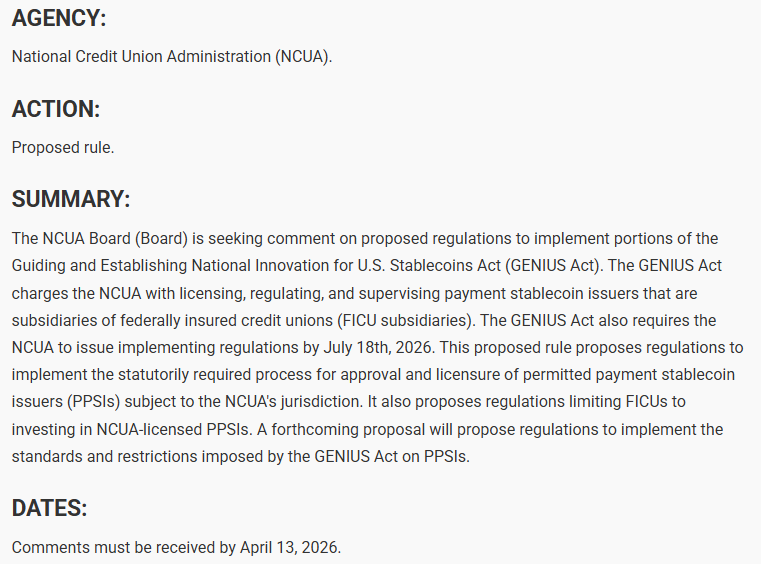
Source: federal register
In simple terms, this means credit unions could eventually create digital dollars that are backed one-to-one by real money and can be used for fast, cheap payments.
These stablecoins would be issued through special subsidiaries and would have to follow strict rules on reserves, transparency, and safety.
What US bank stablecoin issuance means for regular people
For regular people who are curious about crypto but still use traditional banking, this is a pretty big bridge.
It means the financial institutions that many already trust could start offering crypto-friendly tools without forcing anyone to use a separate exchange or wallet.
Traditional finance and crypto are getting closer. Instead of crypto staying completely separate, parts of the everyday banking system could start bringing stablecoin technology inside regulated, familiar institutions.
US bank stablecoin framework signals regulatory shift
Of course, this is still early. The proposal is open for comments, and full rules will take time. But it’s happening.
Regulators are starting to build the actual pathways for crypto to work alongside traditional money, not just saying “crypto is risky.”
From a bigger picture perspective, this fits into a wider trend. The United States is trying to create clear rules so that innovation can happen safely.
When everyday banks and credit unions can participate, it opens the door for more normal people to use stablecoins for payments, remittances, or even earning a bit of yield, all within a system they already know.
Crypto is moving from the edges into the center of finance. Not through hype, but through practical, regulated steps.
For the average person watching from the sidelines, developments like this are worth paying attention to.
They show that the bridge between old money and new technology is being built one piece at a time.

Crypto market researcher and external contributor at Kriptoworld
Wheel. Steam engine. Bitcoin.
📅 Published: February 13, 2026 • 🕓 Last updated: February 13, 2026
✉️ Contact: [email protected]
Disclosure:This article does not contain investment advice or recommendations. Every investment and trading move involves risk, and readers should conduct their own research when making a decision.
Kriptoworld.com accepts no liability for any errors in the articles or for any financial loss resulting from incorrect information.
